Two Way Radios for Trains and How UK Rail Teams Use Push to Talk
How station, depot, security and maintenance teams use two way radios and Push to Talk over Cellular, where they sit alongside GSM-R, and what rail operators should check before choosing a system
Two way radios for trains are push to talk radios that station, depot, security and on-board teams use to coordinate rail operations. In the UK, train drivers and signallers talk over GSM-R, the railway’s own radio network, while operational teams use licensed DMR radios, Push to Talk over Cellular (PoC) or multi-mode radios that run both.
On a weekday morning a service gets diverted. The platform team needs to know before passengers start asking. A security officer on board wants backup at the next stop. The depot needs to know the unit it was expecting won’t arrive until later. And the duty manager wants to hear all of it without ringing four people.
On the railway, those updates often have to travel between sites that are miles apart, and they have to arrive before the next train does. This guide looks at how rail teams use radios to do that, how DMR and PoC compare for rail work, what happens in tunnels and cuttings, and where push to talk sits next to GSM-R and the Rule Book.
What Rail Teams Use Two Way Radios For
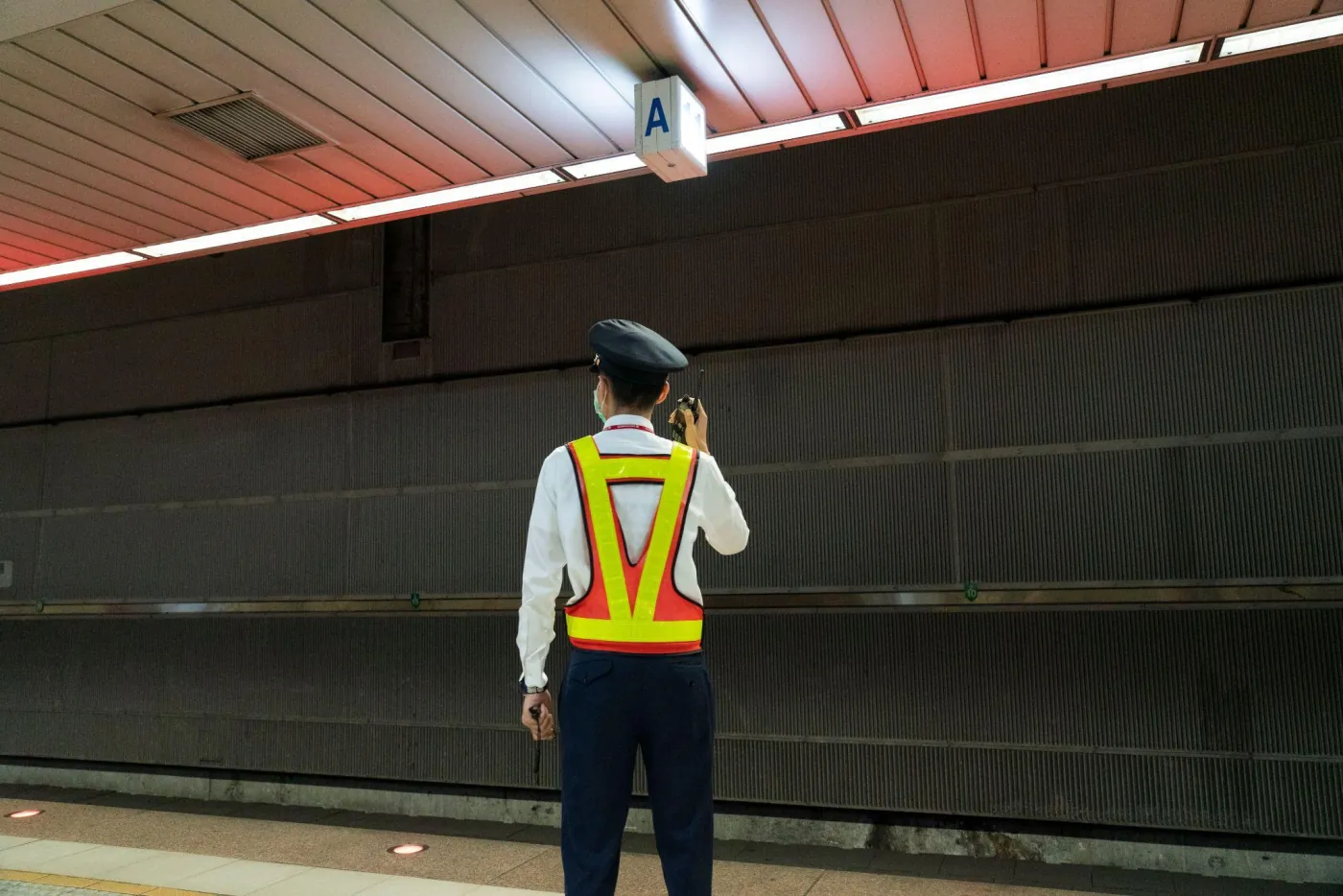
Rail teams use two way radios to run stations, depots and on-board services from one hour to the next. Push to talk lets one person reach a whole team with a single press. It earns its keep during disruption, when platform changes, crowding and replacement buses all have to be sorted at once.
A phone call reaches one person. A radio reaches the whole talkgroup, so everyone hears a platform change or a security call at the same moment. With phones, the last person in the chain can find out ten minutes after the first. On the railway those minutes cost money, because a communication problem during a line closure or a possession can hold up the whole job.
| Rail area | How radio communication helps |
|---|---|
| Stations and platforms | Platform changes, crowding, accessibility assistance and incidents reach the whole station team at once |
| On-board teams | Conductors, hosts and security officers can request support from the next station before the train arrives |
| Security and travel safe teams | Officers patrolling trains and stations stay connected to a control room and can call for backup instantly |
| Depots and maintenance | Fleet engineers, cleaners and depot managers coordinate which units are in, what work is due and when they’re released |
| Disruption and rail replacement | Station teams, controllers and replacement transport coordinators share one channel when services are cut back |
| Engineering projects | Project teams coordinate staff, deliveries and welfare across large sites away from the line itself |
| Control and duty management | Duty managers hear what’s happening across several locations and step in when priorities change |
Who Uses Radios Across Rail Operations
Radios are used by almost everyone who keeps a railway running outside the driving cab, from station managers and platform staff to security officers, depot engineers and control room teams. Most operators split users into a small number of talkgroups, with managers able to hear and reach every group when needed.
- Station managers and duty station managers. Oversee the station and redeploy staff as conditions change through the day.
- Platform and dispatch support staff. Manage crowding, boarding and passenger flow on busy platforms.
- Customer service and ticket office teams. Share live service information so passengers get the same answer from everyone.
- Passenger assistance teams. Coordinate booked and turn-up-and-go assistance between stations, so help is waiting when a passenger arrives.
- Revenue protection officers. Stay in contact with colleagues and control while working on trains and at gatelines.
- Security, travel safe and community officers. Patrol trains and stations, often in pairs or alone, and need instant contact with a control room.
- Conductors and on-board hosts. Request help from the next station for a medical incident, an accessibility need or antisocial behaviour.
- Depot managers and shift leads. Allocate work across the depot and track which units are ready for service.
- Fleet engineers and maintenance technicians. Report faults, request parts and confirm when work on a unit is complete.
- Cleaning and presentation teams. Coordinate turnaround cleans at terminals and depots against tight timings.
- Facilities and station maintenance teams. Respond to lift, escalator, lighting and building faults across a station.
- Car park, retail and concourse staff. Report incidents and hazards on busy concourses and forecourts.
- Rail replacement and disruption coordinators. Organise replacement buses and staff when services are cut back.
- Engineering project and contractor teams. Coordinate people, plant deliveries and welfare on large project sites.
- Control room and operations managers. Oversee multiple stations and depots from one place.
- Mobile operations and on-call managers. Travel between locations during disruption and need to hear every channel.
Keep the number of talkgroups small. Most operations get by with one each for stations, depots, security and management. Managers join several so they can follow what’s going on without anyone having to call them.
Where Push to Talk Fits Alongside GSM-R and Rail Safety Systems
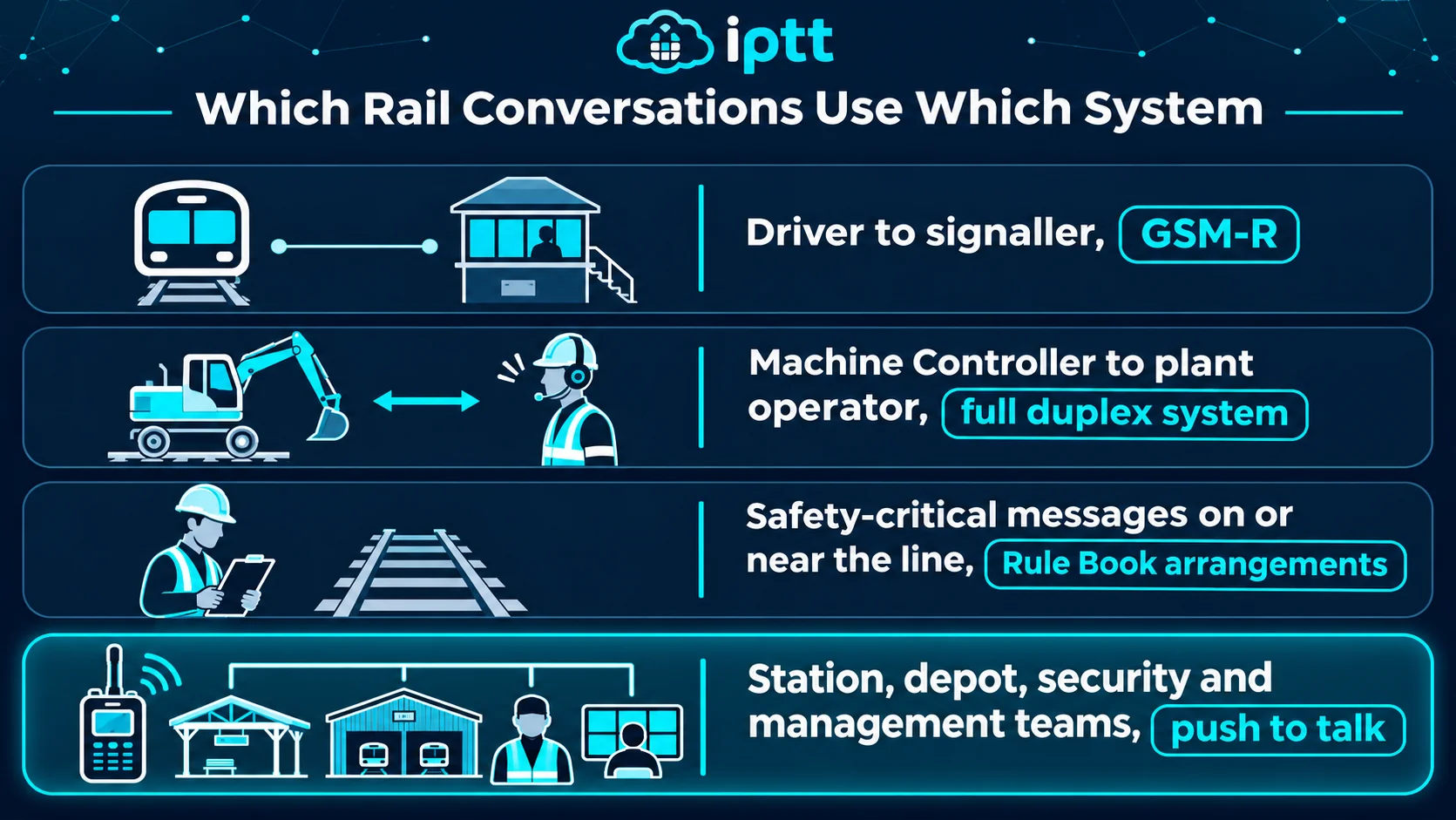
Push to talk handles the operational communication around the railway. It does not replace GSM-R, the railway’s own radio system for communication between drivers and signallers, and it doesn’t replace the communication protocols set out in the Rule Book. Rail operators use push to talk alongside these systems, for the conversations they don’t cover.
GSM-R is the railway’s own radio network. It connects train cabs with signallers across Great Britain. It runs on 2G technology, and Network Rail is preparing to replace it with the Future Railway Mobile Communication System (FRMCS), which is based on 5G. Neither system was built for a station team asking the depot when a unit will be ready, or a security officer calling the control room. Those conversations go over push to talk.
Some safety-critical communication has its own rules. Network Rail’s Infrastructure Plant Manual requires a full duplex system between a Machine Controller and an on-track plant operator, so both can talk and listen at the same time. Push to talk radios, DMR and PoC alike, are half duplex, so only one person speaks at a time. That rules them out for this job. Check any rail radio plan against the Rule Book and the standards that cover the work.
| Communication | System typically used |
|---|---|
| Driver to signaller | GSM-R |
| Machine Controller to on-track plant operator | Full duplex system, as required by Network Rail |
| COSS and safety-critical messages on or near the line | As set out in the Rule Book and the safe system of work |
| Station, depot, security, customer and management teams | Push to talk over DMR, PoC or multi-mode radios |
DMR vs PoC vs Multi-Mode Radios for Rail
Rail operators generally choose between licensed DMR radios, Push to Talk over Cellular (PoC) and multi-mode radios that combine both. DMR works without a mobile network but is limited to radio range. PoC reaches anywhere with mobile coverage and adds GPS and central oversight. Multi-mode radios give staff both on one handset.
Licensed DMR radios don’t use mobile networks, so they keep working where there’s no signal. Range is the catch. It’s typically 2 to 5 km line of sight per site, and going further means repeaters and more Ofcom licensing. That’s fine for one depot or station. Linking a whole route that way gets expensive.
PoC radios run over mobile networks and WiFi instead of radio frequencies. A station in Leeds, a depot in Manchester and a control room in York can all share the same talkgroups, and security officers on board a moving train stay connected as it travels. Ofcom predicts that 96% of the UK landmass has good outdoor 4G coverage from at least one mobile operator. The trade off is that PoC depends on that coverage, and railways run through tunnels and cuttings where signal drops.
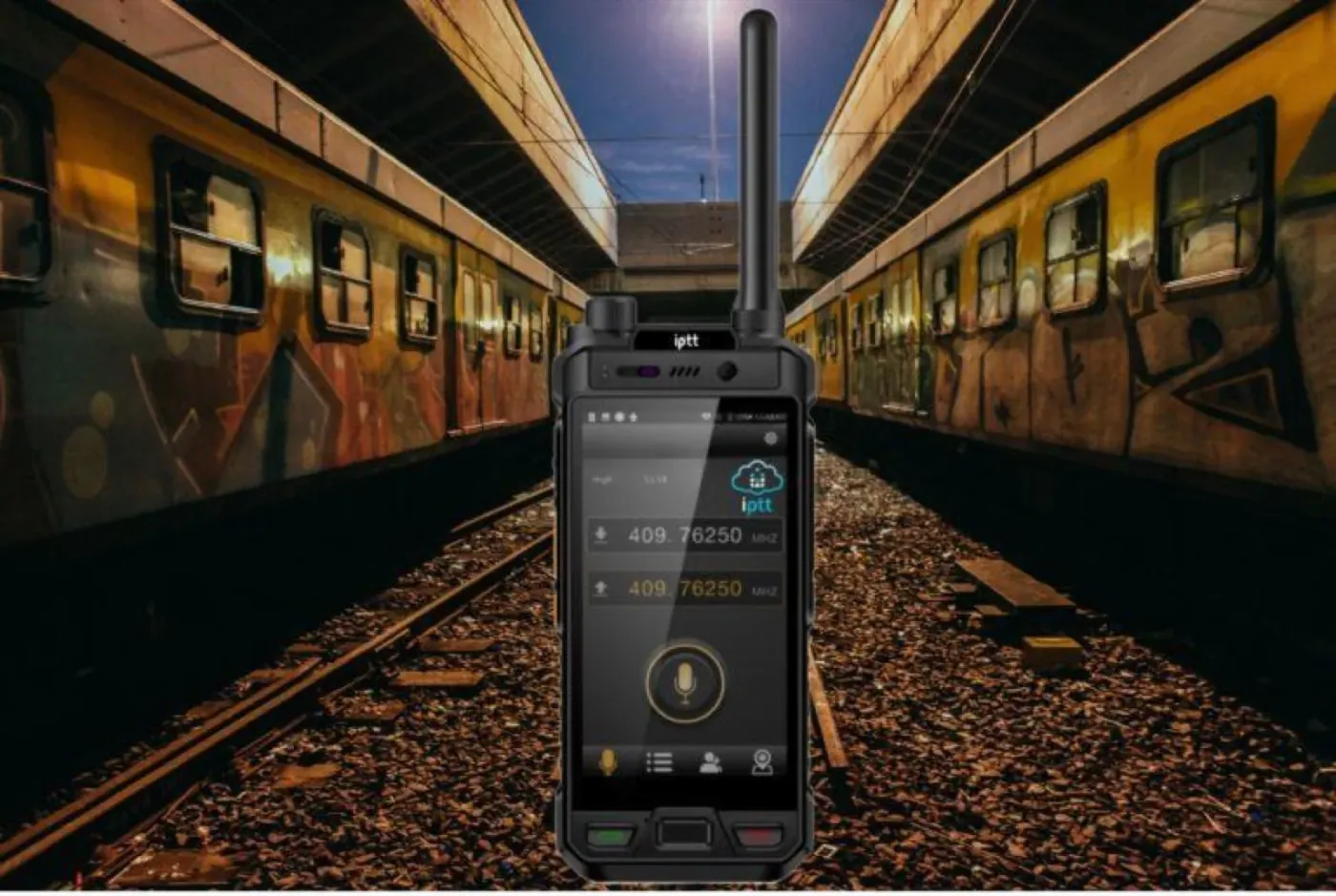
Multi-mode radios such as the iPTT P600 run DMR and PoC on one handset. Staff use PoC for network-wide reach and switch to DMR for direct radio-to-radio contact where mobile signal isn’t available.
| Licensed DMR | Push to Talk over Cellular | Multi-mode (DMR and PoC) | |
|---|---|---|---|
| Best suited for | A single depot or station | Teams spread across stations, depots and routes | Operations that need network reach plus a fallback in no-signal areas |
| Coverage | Within radio range, typically 2 to 5 km line of sight | Anywhere with mobile coverage or WiFi | Both, switching between modes |
| Works without mobile signal | Yes | No | Yes, in DMR mode |
| On-board use | Limited once the train leaves radio range | Stays connected along the route where there’s coverage | Both |
| Licensing | Ofcom licence, plus repeaters for wider coverage | No spectrum licence | Ofcom licence for the DMR side |
| Location and oversight | Possible with GPS radios and compatible dispatch software | Live GPS and central dispatcher | Live GPS and dispatcher in PoC mode |
| Key limitation | Range and the cost of linking several sites | Tunnels, deep cuttings and remote rural stretches | Higher cost per handset than a single-mode radio |
Coverage in Tunnels, Cuttings and Rural Lines
Railways run through tunnels, deep cuttings and rural stretches where mobile signal is weak or absent, so coverage needs checking along the actual routes and sites before rollout. The usual answer is a mix of PoC where there is signal, WiFi where a station or depot has it, and DMR on a multi-mode radio where neither reaches.
GSM-R has its own trackside masts, and Network Rail designed its coverage to include tunnels, cuttings and stations. Public mobile networks, which PoC relies on, weren’t built around the railway in the same way. National coverage figures for them describe outdoor landmass and say nothing about the inside of a tunnel or the bottom of a cutting, where rock, concrete and steep sides block mobile signal. Anyone planning PoC for on-board or station use should assume there will be gaps and plan for them.
iPTT deals with the gaps in a few ways.
- Check coverage on the real routes and sites. Map where staff actually work, including stations below ground, depots, tunnels and the most rural parts of the route, and test handsets there.
- Bring WiFi into the tunnel. WiFi nodes are fitted at the outskirts of the tunnel, and leaky feeder cable carries the signal from outside down through the tunnel itself.
- Use a router with cable repeaters. An external router picks up signal outside, and cable repeaters distribute it through the tunnel.
- Use multi-mode radios where there’s no signal at all. A DMR and PoC handset lets staff keep talking directly to nearby colleagues on DMR when PoC drops out.
With WiFi or repeaters in place, the iPTT Dispatcher stays in contact with devices inside the tunnel. GPS is the exception. Positions can drop out deep inside a tunnel and pick up again once the worker comes out.
iPTT’s SIM roams across four UK mobile networks for both voice calls and data, so each handset uses whichever network is strongest at that point on the route rather than being tied to one operator.
Safety Features for Lone and Isolated Rail Staff
Many rail staff work alone or out of sight for part of their shift, from security officers on late trains to staff at unstaffed or quiet stations and engineers in large depots. Radios with man down, lone worker mode, an emergency button and GPS give those staff a direct line to help when something goes wrong.
Man down raises an alarm automatically if a worker falls or stops moving, which covers the situations where someone is hurt and can’t call for help themselves. Lone worker mode raises an alarm if a worker misses a check-in. An emergency button lets a worker raise the alarm instantly during a confrontation, and GPS shows a responder exactly where they are, including on a moving train. For the wider picture on keeping isolated staff safe, see our guide to lone worker communication systems in the UK.
These features cover personal safety and incident response. Anyone working on or near the line still needs the protection arrangements set out in their safe system of work.
Managing Rail Radios Across a Network
Rail operators run hundreds of radios across many sites, so central management matters as much as the handsets. Dispatcher software shows where staff are and lets a control room talk to any group, and mobile device management (MDM) controls what each handset can be used for.
The iPTT Dispatcher gives a control room live GPS positions on a map and lets operators talk to individual users or whole talkgroups. That means a control room can see which security officer is closest to an incident, or which station team needs extra staff, and act on it straight away. For more on how control rooms manage field teams, see our guide to radio dispatch console systems.
The Dispatcher also gives managers business intelligence and command and control across every site and team.
For rail teams, iPTT supplies the Samsung Galaxy XCover7, a rugged Android handset, managed through Samsung Knox. Knox lets administrators choose which apps, websites and phone numbers each device can reach. A handset locked down this way is harder to misuse, and staff don’t end up treating it as a second phone.
What to Check Before Rolling Out Rail Radios
The right rail radio system depends on where staff work, how far communication needs to reach, and how it fits around the safety systems already in place. Work through these points before choosing hardware.
- Fit with existing safety systems. Confirm which conversations the new radios will carry, and which stay on GSM-R, duplex systems or Rule Book arrangements.
- Coverage on the real routes. Test handsets in stations, depots, tunnels and rural stretches. Ofcom’s 96% figure is outdoor landmass coverage, so it doesn’t guarantee signal underground or in deep cuttings.
- No-signal fallback. Decide how staff stay connected where there’s no mobile signal, whether that’s WiFi with leaky feeder cable in tunnels, a router with cable repeaters or DMR on a multi-mode radio.
- Talkgroup structure. Map out who needs to hear what across stations, depots, security and management before the radios are programmed.
- Lone worker protection. Check the radios support man down, lone worker mode and an emergency button for staff working alone.
- Location and oversight. Decide whether a control room needs live GPS positions, call history or a dispatcher view.
- Device management. Agree what each handset should and shouldn’t be able to do, and how devices will be managed centrally.
- Durability and battery. Match the IP rating to outdoor and depot use, and make sure batteries last a full shift.
- Audio in noisy areas. Check speaker volume and earpiece options for busy platforms and depots.
- Scalability. Consider new stations, timetable changes and peak events, and whether the system scales without new licences or repeaters.
Before you commit. No system guarantees perfect coverage across a rail network. Trial any option on your own routes and sites, including tunnels and below-ground stations, before rolling it out.
How iPTT Can Support Rail Operations
iPTT supplies push to talk communication to train operators, rail security contractors, Network Rail contractors and depots, and is currently working with a major rail company through ESS. Rail teams use the Samsung Galaxy XCover7 with Knox device management, the iPTT PoC app and a SIM that carries voice calls and data across four UK networks.
That combination has put staff in contact on sites that previously had no usable coverage, where they can now take calls and use push to talk. In tunnels, iPTT adds WiFi with leaky feeder cable or routers with cable repeaters, and the iPTT Dispatcher gives the control room one view of every team.

“Communication problems on the railway cost time and money, and they put staff at risk. Our job is to get teams operational from the moment they arrive, even on sites that never had coverage before.”
iPTT can check coverage along your routes and provide demo units, so your teams can test the setup in the places they actually work before anything is bought.
Conclusion
Two way radios carry the everyday conversations that keep a railway running, between stations, depots, trains and the control room. With the industry focused on running the railway safely, they also matter for the people doing the work, giving security officers and staff working alone a quick way to call for help. GSM-R and the Rule Book still cover the safety-critical communication.
For a single depot or station, DMR does the job. For teams spread along a route, PoC reaches further. Operations that need both pick a multi-mode radio. Before choosing any of them, test the handsets on your own routes, tunnels included.
Talk to iPTT About Radios for Rail Operations
If you’re reviewing how your station, depot or security teams stay connected, iPTT can talk you through handsets, coverage and safety features for your network.
FAQs
What kind of radios do trains use?
In the UK, train drivers and signallers talk over GSM-R, a digital radio network built for the railway. Station, depot, security and on-board teams use separate push to talk radios for everyday operational communication, usually licensed DMR, Push to Talk over Cellular (PoC) or multi-mode radios that run both.
Do trains still use analogue radios?
Not on Britain’s mainline railway for driver and signaller communication. GSM-R was phased in between 2007 and 2014 and replaced the old analogue systems, including the National Radio Network and Cab Secure Radio. Handheld radios used by station and depot teams can still be analogue or digital, depending on the operator.
Can push to talk radios replace GSM-R?
No. GSM-R is the dedicated railway system for communication between drivers and signallers, and Network Rail plans to replace it with FRMCS. Push to talk radios are used alongside GSM-R for station, depot, security and management communication.
What is the difference between a walkie talkie and a two way radio?
A walkie talkie is a handheld two way radio, so the terms mostly mean the same thing. Two way radio is the wider term and also covers radios fitted in vehicles and control rooms. PoC radios work like a walkie talkie but send calls over mobile networks, so range isn’t limited to radio distance.
What is the difference between DMR and PoC radios for rail?
DMR radios use licensed radio frequencies and work without mobile signal, but only within radio range. PoC radios run over mobile networks, so they connect teams across a whole route or region, with live GPS and a central dispatcher. Multi-mode radios combine both on one handset.
How far can a two way radio reach on the railway?
A traditional DMR radio typically reaches 2 to 5 km line of sight, and further with repeaters. A PoC radio has no fixed range limit, because it works anywhere with mobile coverage or WiFi, so a station team can talk to a depot or control room at the other end of the country.
What are the disadvantages of two way radios?
Traditional radios have limited range, need an Ofcom licence and repeaters to cover wide areas, and only let one person speak at a time. PoC radios remove the range limit and the licence, but depend on mobile signal, so tunnels and deep cuttings need a fallback such as DMR or WiFi.
Do PoC radios work in railway tunnels?
PoC radios need mobile signal or WiFi, so they can lose connection in tunnels where public mobile coverage is weak. The usual fix is WiFi at the tunnel entrance carried inside on leaky feeder cable, or a router with cable repeaters. Multi-mode radios that also run DMR are another option.
Are push to talk radios suitable for on-track plant communication?
Not on Network Rail managed infrastructure. Network Rail requires a full duplex communication system between a Machine Controller and an on-track plant operator. Push to talk radios are half duplex, so they’re used for operational team communication rather than controlling on-track plant.
How can rail operators improve communication between stations and depots?
Put stations, depots, security and management on shared push to talk talkgroups so one update reaches everyone at once. Test coverage on the real routes, use multi-mode radios where signal drops, and give the control room a dispatcher view with live GPS.
Sources
- Ofcom, Connected Nations update Spring 2026
- Network Rail Safety Central, RRV duplex communications
- Network Rail, GSM-R, the railway’s mobile communication system
- Find a Tender, Future Railway Mobile Communication System (FRMCS) trackside civils request for information
- Office of Rail and Road, RAIB recommendation response on COSS and lookout communication, Peterborough