
Man Down Radios and How They Keep UK Workers Safe
How man down detection works on a two way radio, how it differs from lone worker protection, and what UK employers should look for when choosing a system
A man down radio is a two way radio that raises an alarm automatically when its user falls or stops moving. A built in sensor detects the fall or the stillness, the radio gives the worker a short warning they can cancel, and if they don’t, it sends an emergency alert to a supervisor or control room, often with their GPS location.
That matters most for people working alone. A fall from a ladder in an empty plant room or a collapse during a night patrol can go unnoticed for a long time when the worker can’t call for help. For organisations with staff working alone or out of sight, man down is one of the most practical safety features a radio can have.

What Is a Man Down Radio
A man down radio is a two way radio with an extra safety function built in. A motion sensor inside the handset tracks its angle and movement, so the radio can tell when its user may have fallen or collapsed and raise the alarm on their behalf. It works the same way on traditional radios and on radios that run over mobile networks.
Most radios use one or both of two triggers. A tilt trigger fires when the radio moves from upright to near horizontal, which is what tends to happen when someone falls while the radio is clipped to their belt or vest. A no-movement trigger fires when the radio detects no motion at all for a set time, which can catch a worker who has collapsed without falling far.
The angle and the time delay are set when the radio is programmed, so they can be matched to the work. A security guard on foot patrol and an engineer who spends long periods kneeling at a panel will need different settings, otherwise the alarm could go off during normal activity.
How Man Down Works on a Radio
Man down works as a short chain of events. The sensor detects a fall or a lack of movement, the radio gives the user a local warning, and if the warning isn’t cancelled in time the radio sends an emergency alert, usually with the worker’s GPS position, to whoever is monitoring the system.
- The sensor detects the trigger, either a tilt beyond the programmed angle or no movement for the set amount of time.
- The radio sounds a pre-alert tone or vibrates, giving the worker a short window to cancel it if they are fine.
- If the pre-alert isn’t cancelled, the radio sends an emergency alarm to the talkgroup, supervisor or control room.
- On radios with GPS, the alert carries the worker’s last known location so responders know where to go.
- On some systems like iPTT’s, the radio also automatically opens its microphone so the control room can hear what is happening around the worker.
The radio raises the alarm. What happens next depends on the response plan the employer has in place, so the escalation route needs to be agreed before the radios go out, not after the first real alert.

Man Down vs Lone Worker Protection
Man down and lone worker functions are related but they detect different things. Man down reacts to how the radio is moving. Lone worker mode reacts to how the user is behaving, usually through a check-in timer that raises an alarm if the worker hasn’t pressed a button or used the radio within a set period.
Most radios that offer one also offer the other, alongside a manual emergency button. Each one covers a gap the others leave.
| Safety feature | What triggers it | The situation it covers |
|---|---|---|
| Emergency button | The worker presses it | The worker is conscious and can reach the radio |
| Man down | The radio tilts or stops moving | The worker has fallen or collapsed and can’t raise the alarm |
| Lone worker timer | A check-in is missed | Something has gone wrong that doesn’t involve a fall, or the radio has been left behind |
Man down is one part of a wider approach to keeping isolated staff safe. For the bigger picture on coverage, escalation and the systems employers use, see our guide to lone worker communication systems in the UK.
Man Down on Traditional Radios and PoC
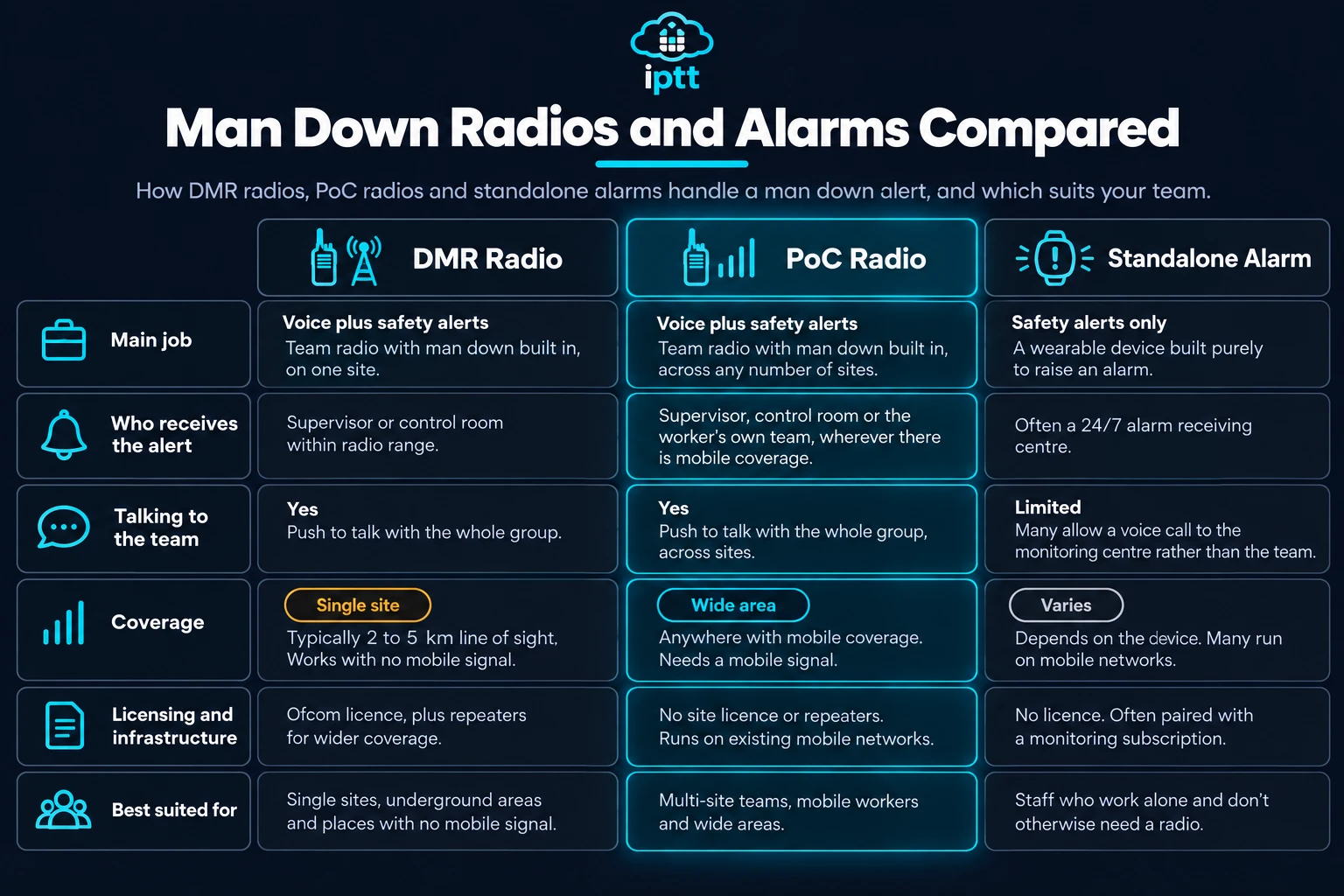
Man down is available on traditional Digital Mobile Radios (DMR) and on Push to Talk over Cellular (PoC) radios. The sensor works the same way on both. The difference is how far the alert can travel, how the worker’s location reaches the responder, and what it costs to set up and run.
On DMR radios, man down is often a factory option, a paid feature licence or an add-on board depending on the model, so it needs specifying at purchase. The alert reaches as far as the radio network does. On a single site that typically means line of sight range of 2 to 5 km, and wider coverage means adding repeaters and Ofcom licensing. DMR’s strength is that it doesn’t rely on a mobile network, which matters on sites with little to no signal.
PoC radios send the alert over mobile networks, so it can reach a supervisor or control room wherever there is coverage, whether that is the next building or another county. Ofcom predicts that 96% of the UK landmass has good 4G coverage from at least one operator. The worker’s GPS position can show on a dispatcher map, and there is no site licence to apply for. The trade off is that the radio depends on mobile coverage, so basements, plant rooms and steel structures need checking.
| Traditional DMR radio | PoC radio | |
|---|---|---|
| How man down is supplied | Often a factory option, licence or add-on board, depending on the model | Built into handsets that list it as a feature |
| How far the alert travels | Within radio range, typically 2 to 5 km line of sight per site | Anywhere with mobile network coverage |
| Worker location | Needs GPS-capable radios and compatible dispatch software | GPS position can show live on a dispatcher map |
| Licensing and infrastructure | Ofcom licence, plus repeaters for wider coverage | No site licence or repeaters, runs on mobile networks |
| Multi-site oversight | Each site needs its own coverage | One control room can see every site |
| Works without mobile signal | Yes | No |
| Best suited for | Single sites, underground or no-signal areas | Multi-site teams, mobile workers, wide areas |
Some sites need both. Hybrid handsets such as the iPTT P600 run DMR and PoC in one device, so a worker can stay on DMR in a no-signal area and switch to PoC everywhere else.
Man Down Radios vs Standalone Man Down Alarms
A man down radio and a standalone man down alarm both detect falls and lack of movement, but they do different jobs. A standalone alarm is built only to raise an alert, often to a monitoring centre.
Standalone man down alarms are usually small devices worn on a lanyard, belt clip or ID badge holder. Many connect to a 24/7 alarm receiving centre, and the monitoring services can be certified against BS 8484, the British Standard code of practice for lone worker services. They suit staff who don’t otherwise need a radio, such as community workers visiting clients on their own.
A man down radio puts the alarm into a device the worker already carries for their job. When an alert comes in, the supervisor can talk straight back to the worker, or to the nearest colleague who can get there first. For teams who already use radios, it saves carrying a second device and keeps safety alerts inside the system the team uses all shift.
| Man down radio | Standalone man down alarm | |
|---|---|---|
| Main job | Team voice communication plus safety alerts | Safety alerts |
| Who receives the alert | Supervisor, control room or the worker’s own team | Often a 24/7 alarm receiving centre |
| Talking to colleagues | Push to talk with the whole group | Many allow a voice call to the monitoring centre rather than the team |
| Best suited for | Teams who already need radios for their work | Staff who work alone and don’t otherwise need a radio |
Is Man Down a Legal Requirement in the UK
No UK law specifically requires man down radios. Employers have a general duty under the Health and Safety at Work etc. Act 1974 to protect employees as far as reasonably practicable, and HSE guidance expects lone working risks to be assessed and controlled before the work starts.
The Health and Safety Executive’s lone working guidance says employers should provide training, supervision, monitoring and support for people who work alone. Man down radios are one way of meeting part of that duty, particularly where a risk assessment shows a worker could be injured and unable to call for help. Whether they are the right control depends on the risk assessment, not on a rule that says every lone worker needs one.
Industries That Need Man Down Radios
Any role where someone works alone, at height, around machinery or out of sight of colleagues is a candidate for man down. In practice that covers a wide range of UK sectors, from building sites and warehouses to farms, depots and hotels at night.
- Construction. Supervisors, inspectors and trades working alone on scaffolding, in plant areas or on unfinished floors, where a fall from height is exactly the situation man down is built to catch. See our guide to construction site radios.
- Security and patrol. Guards on night shifts and static posts, often the only person on site. See our guide to security communication devices.
- Facilities and property management. Maintenance engineers on rooftops, in plant rooms and in underground service areas.
- Utilities and energy. Field engineers working on networks, substations and remote infrastructure.
- Warehousing and logistics. Staff working alone in large buildings, cold stores or yards, and drivers at depots.
- Waste and recycling. Operatives around heavy plant and vehicles, often on large open sites.
- Agriculture and estates. Farm workers, gamekeepers and estate staff covering large areas with patchy supervision.
- Healthcare and community care. Staff visiting patients alone or working in isolated parts of a site.
- Hospitality. Night porters, maintenance and security staff covering a building with few colleagues on shift.
- Events. Crew working early setup and late breakdown shifts before and after the main team is on site.
- Education. Caretakers and site teams working out of hours on school, college and university campuses.
What to Consider When Choosing a Man Down System
The right man down system depends on where your people work and who will respond when an alert goes off. Work through these points before choosing hardware, because getting the response side wrong makes the best radio far less useful.
- Coverage. Decide where alerts need to reach, one site or several regions. PoC relies on mobile coverage, and Ofcom predicts 96% of the UK landmass has good 4G from at least one operator (Connected Nations, Spring 2026). The remaining gaps are mostly rural.
- Dead spots. Basements, plant rooms, lift shafts and steel structures can block signal on any system. Test these areas before rollout.
- Location. GPS helps responders find a worker fast, but it is less accurate indoors. Check how location will be shown and how precise it needs to be.
- Who monitors alerts. A control room, a duty supervisor or a dispatcher. Someone has to be watching at every hour a lone worker is on shift.
- Escalation routing. Agree who gets the alert first and what happens if they don’t respond.
- False alarm handling. Choose radios where the tilt angle and pre-alert timer can be adjusted, ideally remotely, and train staff to cancel a false alert rather than switch the feature off.
- Battery life. The radio needs to last a full shift with man down and GPS running.
- The other safety features. Check the radio also has an emergency button and a lone worker timer, so the gaps man down doesn’t cover are still covered.
Before you commit, bear in mind that no system guarantees perfect coverage. Test the radios on the real site, in the real buildings, before rolling them out.
Free Man Down Radio Checklist
Our one-page, 8 step checklist helps you work out whether man down protection fits your team, and what to put in place before rollout. Print it and work through it with your site or safety lead.
Download the Checklist (PDF)
How iPTT Supports Man Down Safety
Man down is built into iPTT’s P400, P500 and P600 handsets and the iPTT app, at no extra cost. When it triggers, the alert appears on the iPTT Dispatcher as an SOS with the worker’s location, and the radio opens its microphone automatically so the control room can hear what is happening and talk straight back.
The tilt angle and timer can be changed remotely, so settings can be matched to each role, such as a patrol guard or an engineer who kneels at panels, without collecting the radios. The handsets also include lone worker mode and an emergency button, and run on iPTT’s multi-network SIM, which roams across four UK mobile networks and connects automatically to the strongest provider. The P600 adds DMR for areas with no mobile signal.
Conclusion
Man down radios deal with one specific risk, a worker who is hurt and can’t call for help. The radio detects the fall or the stillness and raises the alarm on their behalf, with their location if GPS is fitted.
Both DMR and PoC radios can do this. DMR suits single sites and areas with no mobile signal. PoC suits teams spread across sites or travelling between them. Whichever is chosen, the radio is only half the system. Employers also need someone monitoring alerts, a clear escalation route and staff who know how it works.
Talk to iPTT About Man Down Radios
If your organisation has people working alone, iPTT can talk you through man down, lone worker and GPS options for your sites.
FAQs
What is a man down radio?
A man down radio is a two way radio with a motion sensor that raises an alarm if its user falls or stops moving. After a short warning the user can cancel, it sends an emergency alert to a supervisor or control room, often with the worker’s GPS location.
How does man down detection work?
Man down detection uses a sensor in the radio to watch for a tilt beyond a set angle or no movement for a set time. When either happens, the radio gives a pre-alert. If the user doesn’t cancel it, the radio sends an emergency alarm to the people monitoring the system.
Is man down the same as a lone worker alarm?
No. Man down reacts to the radio’s movement, such as a fall. A lone worker alarm usually works on a check-in timer and raises an alert if the worker misses a check-in. Many radios offer both, alongside a manual emergency button.
What is the difference between a man down radio and a man down alarm?
A standalone man down alarm is a small wearable device that raises an alert, often to a 24/7 monitoring centre. A man down radio raises the same kind of alert but also gives the worker push to talk with their team. Alarms suit staff who don’t need a radio. Radios suit teams who already use one for their work.
Do man down radios work without mobile signal?
It depends on the radio. Traditional DMR radios send man down alerts over their own radio network, so they work without mobile signal. PoC radios send alerts over mobile networks and need coverage. Hybrid radios that run both DMR and PoC can cover both situations.
How can employers improve lone worker safety with man down radios?
Employers get the most from man down radios by pairing them with a clear response plan. That means assessing lone working risks, setting tilt and timer thresholds to suit each role, making sure someone monitors alerts at all times, agreeing an escalation route and training staff to use and cancel the feature properly.