PoC Radios vs Traditional Two-Way Radios: Which Is Right for UK Organisations?
A practical comparison of coverage, cost, security and scalability to help you choose the right communication system for your team

Picture this: your site manager is on the far end of a multi-storey construction project. He keys his radio. Nothing but static. He tries again. The signal barely gets through. Meanwhile, a delivery is missed, a safety issue goes unreported, and the whole operation loses twenty minutes.
This is a daily reality for UK organisations still relying on traditional two-way radios beyond their effective range. Push-to-Talk over Cellular (PoC) radios offer a fundamentally different approach — using 4G and 5G mobile networks instead of radio frequencies to deliver instant, clear communication anywhere in the country.
But which system is actually right for your organisation? This guide breaks down the real differences — covering coverage, cost, security, features and long-term scalability — so you can make an informed decision.
Quick Comparison: PoC vs Traditional Two-Way Radios
Before diving into the detail, here is how the two technologies compare side by side across the factors that matter most to UK organisations.
| Factor | Traditional Two-Way Radio | PoC Radio (4G/5G) |
|---|---|---|
| Coverage | Limited — line-of-sight, ~2–5 km | Nationwide via mobile networks |
| Infrastructure needed | Repeaters, licensed frequencies | SIM card only — no extra hardware |
| Range limit | Terrain & buildings reduce coverage | Works anywhere with mobile signal |
| GPS tracking | Not standard | Built-in on most platforms |
| Encryption | Varies — analogue often unsecured | AES encrypted data transmission |
| Scalability | New hardware per new user | Add users instantly via software |
| Device compatibility | Dedicated radios only | Radios, smartphones and tablets |
| Call recording | Rarely available | Standard on most PoC platforms |
| Long-term cost | Hardware + repeaters + licensing | Subscription model — predictable |
How Each System Works
Traditional Two-Way Radios
Traditional radios transmit voice directly over UHF or VHF radio frequencies. When you press the push-to-talk button, your voice is broadcast over the air to any radio tuned to the same channel — instantly, with no network required.
This simplicity is their greatest strength and their biggest limitation. In a small, open environment — a warehouse, a small site, a single venue floor — they work reliably and cheaply. The moment you move into a multi-storey building, a large outdoor site or an area with dense infrastructure, the signal degrades. Concrete walls, steel frames and uneven terrain all reduce range, sometimes dramatically.
Expanding coverage requires repeaters — additional hardware that must be installed, licensed and maintained. Each repeater adds cost and complexity. A large organisation covering multiple sites can end up with a surprisingly expensive and fragile infrastructure.
PoC Radios
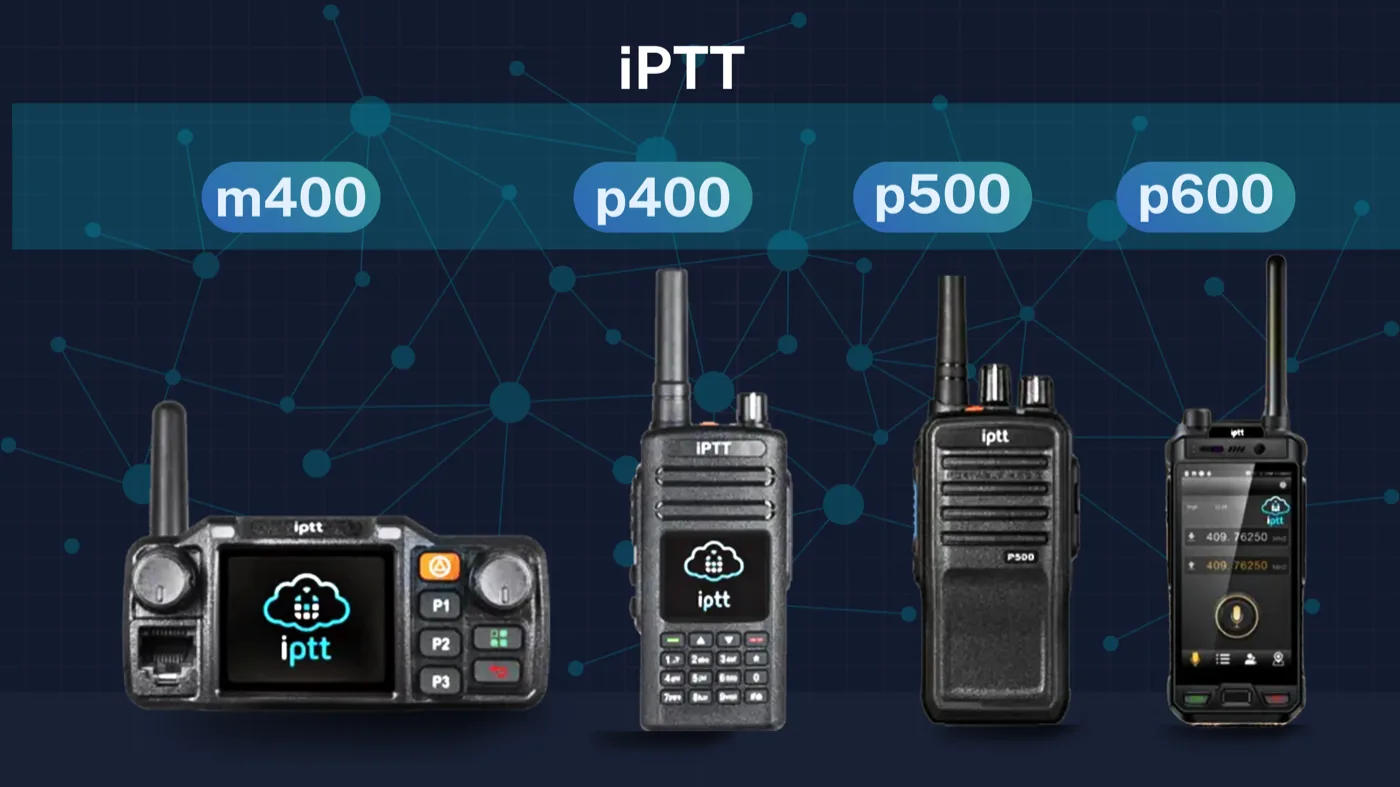
PoC radios work entirely differently. Instead of broadcasting over the air, they transmit voice as encrypted data across 4G and 5G mobile networks — the same infrastructure your smartphone uses, but optimised for instant push-to-talk communication. iPTT's PoC radio range includes rugged dedicated handsets as well as devices that work alongside smartphones and tablets, making them easy to integrate into existing team setups.
Because PoC relies on mobile networks, coverage is nationwide by default. Multi-network SIM cards — which automatically switch between the UK's major networks — ensure devices stay connected even in areas where one provider has weaker signal. No repeaters. No licensed frequencies. No site surveys.
KEY POINT
PoC radios remove the ceiling on where your team can communicate. If there is mobile signal, there is communication — across one site, across the country, or both simultaneously.
Coverage and Range: The Biggest Difference
For many UK organisations, coverage is the deciding factor.
Traditional radios typically cover two to five kilometres in open conditions. That figure drops significantly indoors, underground or across complex terrain. A security team patrolling a large shopping centre, a logistics company managing drivers across a county, or a construction firm coordinating across multiple sites will all encounter real gaps with traditional systems.
PoC radios eliminate range as a variable. A site manager in Manchester and a driver in London can communicate with the same clarity and speed as two people on the same floor. For organisations with distributed teams, mobile workforces or multiple locations, this is a transformative difference.
INDUSTRY INSIGHT
According to Ofcom's infrastructure research, the UK's mobile network infrastructure has reached strong coverage levels across most of the country, with ongoing investment in rural and underground connectivity. This makes PoC an increasingly reliable choice even in locations that were previously considered marginal for mobile coverage.
Features That Traditional Radios Simply Cannot Match
Traditional two-way radios do one thing well: instant voice. For simple environments, that is often enough. For more complex operations, the lack of additional capability becomes a genuine operational constraint.
PoC platforms typically include:
- Live GPS tracking — see every team member's location in real time on a central map
- Dispatcher software — manage talk groups, monitor activity and broadcast to all users from a control interface
- Call recording — every communication logged automatically for accountability and compliance
- Emergency alerts — a single button press flags a distress situation and notifies supervisors instantly
- Multimedia messaging — share images, documents and status updates alongside voice
- Remote management — add users, change permissions and update settings without touching a device
For industries like security, logistics, healthcare support and event management — where accountability and situational awareness matter — these features represent a meaningful operational upgrade, not just a nice-to-have.
Cost and Scalability: Thinking Beyond the Upfront Price
Traditional radios often appear cheaper at the point of purchase. A basic UHF handset can cost as little as £50–£150. That comparison changes quickly when you factor in the full picture.
A traditional radio system for a 50-person team operating across a large site might require:
- Multiple repeaters at £300–£800+ each
- Ofcom radio spectrum licensing fees
- Annual maintenance and battery replacement
- Hardware replacement if the site layout changes
PoC systems operate on a subscription model — typically a monthly fee per device covering connectivity, software, platform management and support. The upfront cost is higher than a basic two-way radio, but there is no infrastructure spend, no licensing complexity and no per-site hardware.
SCALING ADVANTAGE
Adding ten new users to a traditional system means purchasing ten new radios and potentially upgrading infrastructure. Adding ten users to a PoC platform is a software change. For growing organisations or those with seasonal workforce fluctuations, this flexibility has direct financial value.
Security: Why It Matters More Than Most Organisations Realise
This is an area where the gap between the two technologies is significant — and underappreciated.
Analogue two-way radios are, by design, broadcast communications. Anyone with a compatible radio tuned to the same frequency can listen in. Even digital radios offer variable levels of protection — encryption quality depends heavily on the specific model and how it has been configured.
PoC systems transmit voice as encrypted data using AES-256 encryption — the same standard used by financial institutions and government systems. Communications travel through private servers and secure data pipelines, not open airwaves. For organisations handling sensitive operational information, client data or anything that would be damaging if intercepted, this level of protection is not optional.
Read more about radio encryption standards and why they matter for professional organisations.
Which System Is Right for Your Organisation?
Traditional two-way radios are still the right answer in specific circumstances. If your team operates within a small, clearly defined area, has no need for GPS tracking or call management, and your budget is very limited, a basic radio system may serve you well.
For the majority of UK organisations operating in 2025 — with distributed teams, compliance requirements, mobile workforces and growth ambitions — PoC radios represent a more capable, more flexible and ultimately more cost-effective long-term solution.
The question is not which technology is newer. It is which system will still be serving your organisation effectively in three years — and which one you will have outgrown.
PoC is particularly well suited to:
- Security teams covering large venues or multiple patrol zones
- Logistics and transport operations managing drivers across regions
- Construction firms coordinating across large or multi-site projects
- Event management teams requiring fast setup and teardown
- Local councils and housing associations with dispersed mobile staff
- Retail or hospitality groups managing communication across branches
In Summary
Traditional two-way radios remain reliable tools for simple, short-range communication on small sites. But for UK organisations that need nationwide coverage, modern features, strong security and the ability to scale without infrastructure headaches, PoC radios are the clear choice.
iPTT's PoC radio devices, paired with multi-network SIM cards and full dispatcher software, give your team reliable communication without the complexity or cost of traditional radio infrastructure. Whether you manage five people or five hundred, across one site or the whole country.
Frequently Asked Questions
What is the main difference between PoC radios and traditional two-way radios?
Traditional two-way radios use UHF or VHF radio frequencies and are limited by range and terrain — typically two to five kilometres in open conditions. PoC radios transmit voice as encrypted data across 4G and 5G mobile networks, providing nationwide coverage with no range ceiling.
Do PoC radios work without mobile signal?
PoC radios require mobile data connectivity to function. In the UK, iPTT's multi-network SIM cards automatically switch between major networks to maximise uptime — but coverage in very remote areas without any mobile signal remains a limitation, just as it would for a smartphone.
Are PoC radios secure enough for professional use?
Yes. PoC systems use AES-256 encrypted data transmission through private servers — the same encryption standard used in banking and government communications. This significantly exceeds the security level of most traditional analogue and even many digital radio systems.
Which industries benefit most from switching to PoC?
Security, logistics and transport, construction, event management, local authorities and retail groups all see strong operational benefits from PoC — particularly organisations with mobile teams, multiple sites or compliance requirements around communication logging.
Can PoC radios replace traditional two-way radios entirely?
In most commercial and non-emergency settings, yes. Emergency services use specialist networks such as TETRA for mission-critical resilience. For businesses, PoC delivers comparable reliability with significantly more capability.
Are traditional two-way radios still worth buying in 2025?
For very small teams, short-range simple environments, or situations where mobile connectivity is genuinely unavailable, traditional radios remain a practical option. For the majority of UK organisations, PoC now offers better long-term value.
Related Reading
Thank you for reading. Explore our full news and insights section for more articles on professional radio communication.