Best Two Way Radios for Warehouses in the UK
How UK warehouses use two way radios, walkie talkies and PoC to connect goods-in, picking and forklifts, fix dead spots and choose the right system
Two way radios for warehouses let goods-in, picking, forklift drivers and dispatch talk to each other instantly at the press of a button, without dialling or stopping work. Most UK warehouses use licensed DMR radios or Push to Talk over Cellular (PoC), and PoC also connects the warehouse floor with drivers on the road and managers at other sites.
A modern warehouse runs on timing. Inbound vehicles arrive in tight slots, pickers work against order cut-offs, forklifts move loads through narrow aisles and outbound trailers wait at the bay for the last pallets. When something changes, the right person needs to hear about it immediately, and a phone left in a locker or a shout across a loud building won’t do that.
This guide covers who uses radios in a warehouse, how to choose the best two way radios for warehouse use, how PMR446, DMR and PoC compare, and how to handle coverage in large buildings and basements.
Why Warehouses Need Reliable Communication
Warehouses need reliable communication because the work is fast, spread across a large floor and involves moving vehicles around people. When goods-in, picking, lift trucks and dispatch can’t reach each other instantly, small problems turn into missed slots, picking errors, idle trucks and avoidable safety risks.
A single delay at goods-in can hold up putaway, which holds up picking, which leaves a driver waiting at the bay. Radios keep those handovers moving because the right person hears about a change straight away, wherever they are on site. A phone call reaches one person at a time, while a radio reaches a whole talkgroup with one press and works with gloves and earpieces.
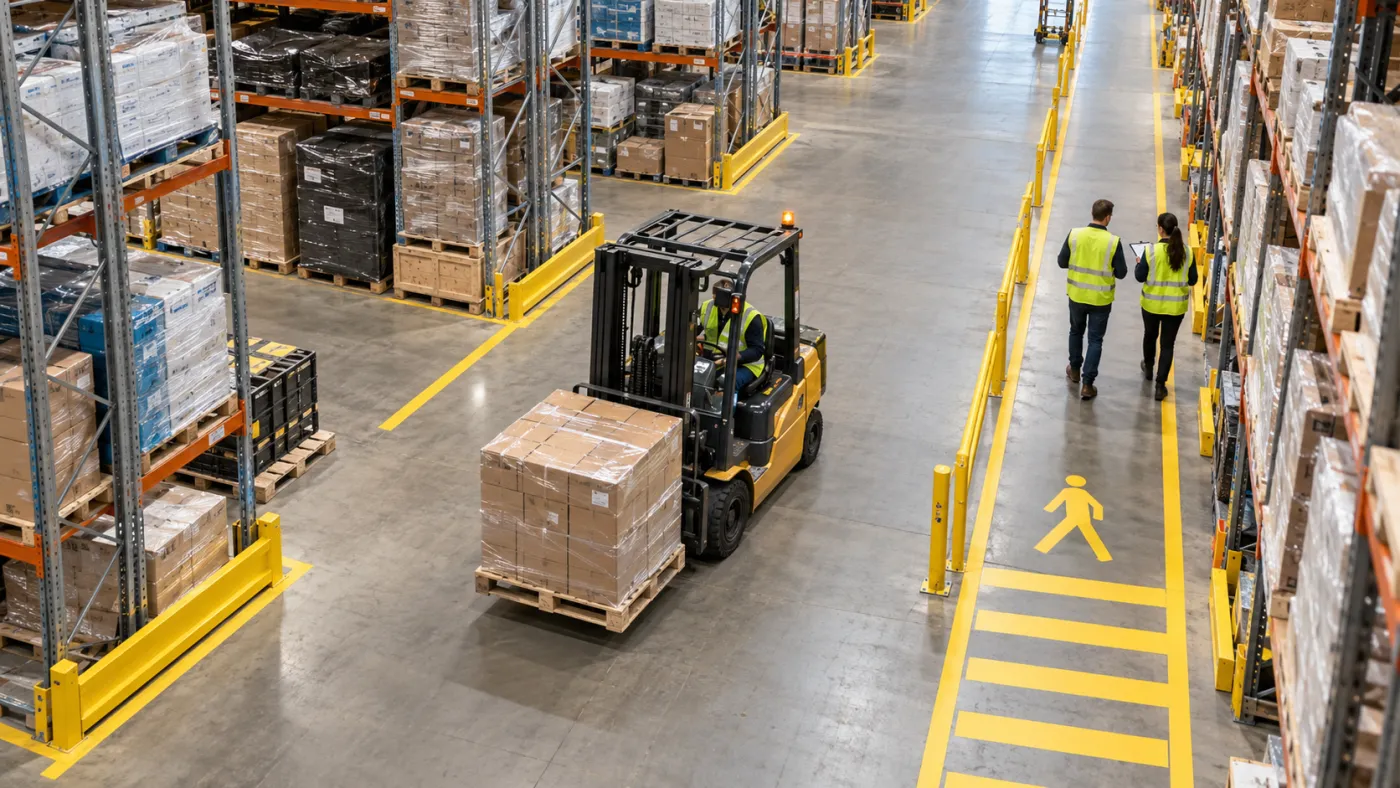
Safety is the other half of it. According to the Health and Safety Executive, lift trucks are involved in about a quarter of all workplace transport accidents, and HSE links many of those accidents to poor supervision and a lack of training. Training is down to the employer, but instant contact between forklift drivers, pedestrians and supervisors makes the supervision side easier to do well.
Reaching Drivers and Managers Beyond the Site
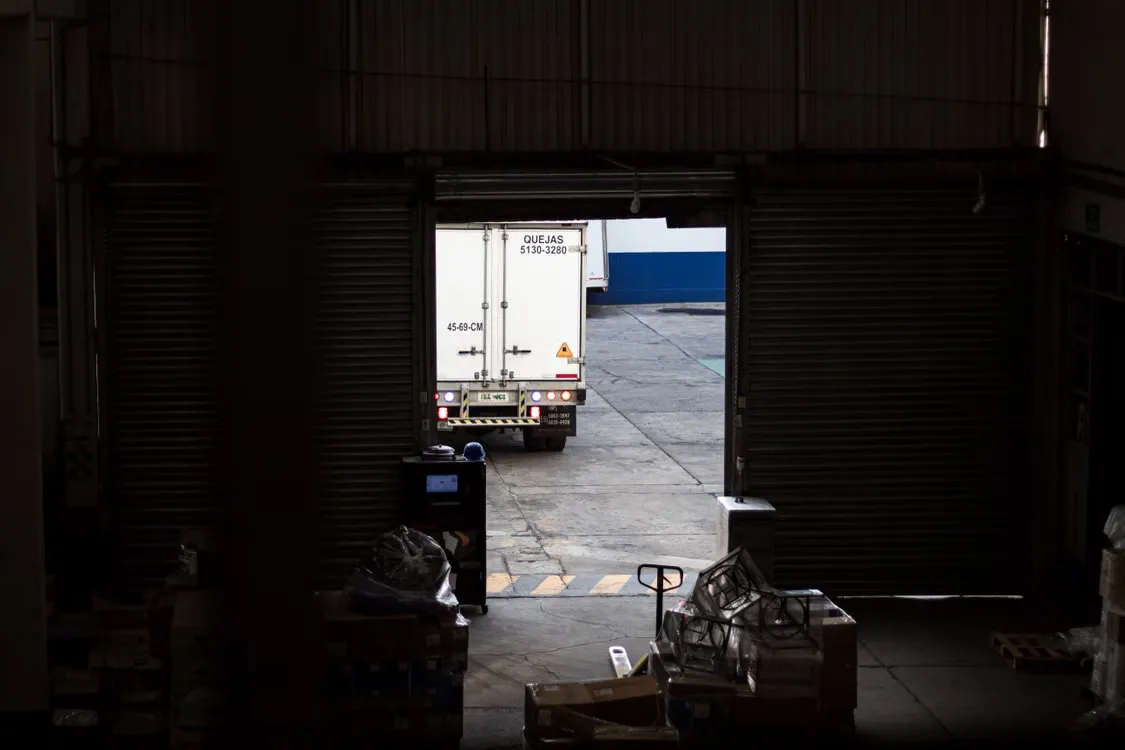
Warehouse communication doesn’t stop at the warehouse walls. Goods-in needs to know when inbound drivers are running late, and managers often sit at another site entirely. This is the main reason warehouses move from DMR to Push to Talk over Cellular.

“When warehouses come to us, they’re typically on a DMR system. They switch because it lets them talk to drivers who are hundreds of miles away and coordinate before they arrive. Management teams who aren’t in the warehouse can listen to comms and respond.”
A warehouse in Bristol, its management team in London and its trucks on the road around Newcastle can all share the same talkgroups. For fleets, routes and depots, see our guide to transport communication systems for logistics teams.
Where Radios Help Inside the Warehouse
| Warehouse area | How radio communication helps |
|---|---|
| Goods-in and receiving | Inbound arrivals, early vehicles and discrepancies reach the right team straight away |
| Putaway and replenishment | Lift truck operators get the next task without returning to a terminal or office |
| Picking and packing | Shortages, damaged stock and urgent orders are flagged without leaving the aisle |
| Loading bays and dispatch | Bay changes, late pallets and trailer readiness are coordinated in real time |
| Yard | Vehicle movements and trailer swaps are coordinated with the shift manager and gatehouse |
| Health and safety | Incidents, spills and near misses are reported instantly so the area can be made safe |
Who Uses Radios in a Warehouse
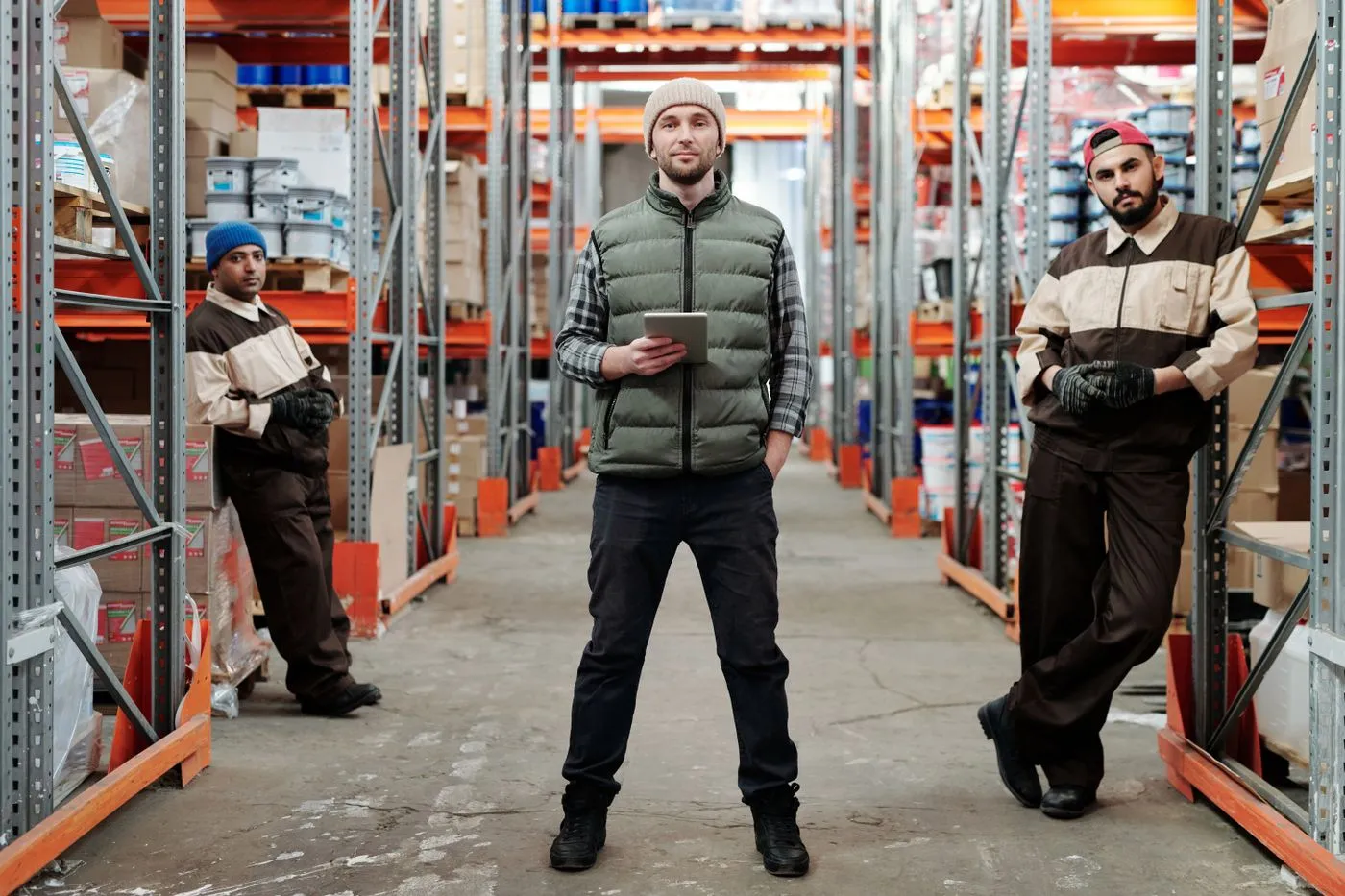
Radios are used by almost everyone who keeps stock moving through a warehouse, from shift managers and lift truck operators to pickers, loading bay staff and security. Teams are grouped into a small number of talkgroups, with managers able to hear and reach everyone when needed.
- Warehouse and operations managers. Oversee the whole site and step in when priorities change.
- Shift managers and team leaders. Allocate labour between areas as volumes rise and fall through the shift.
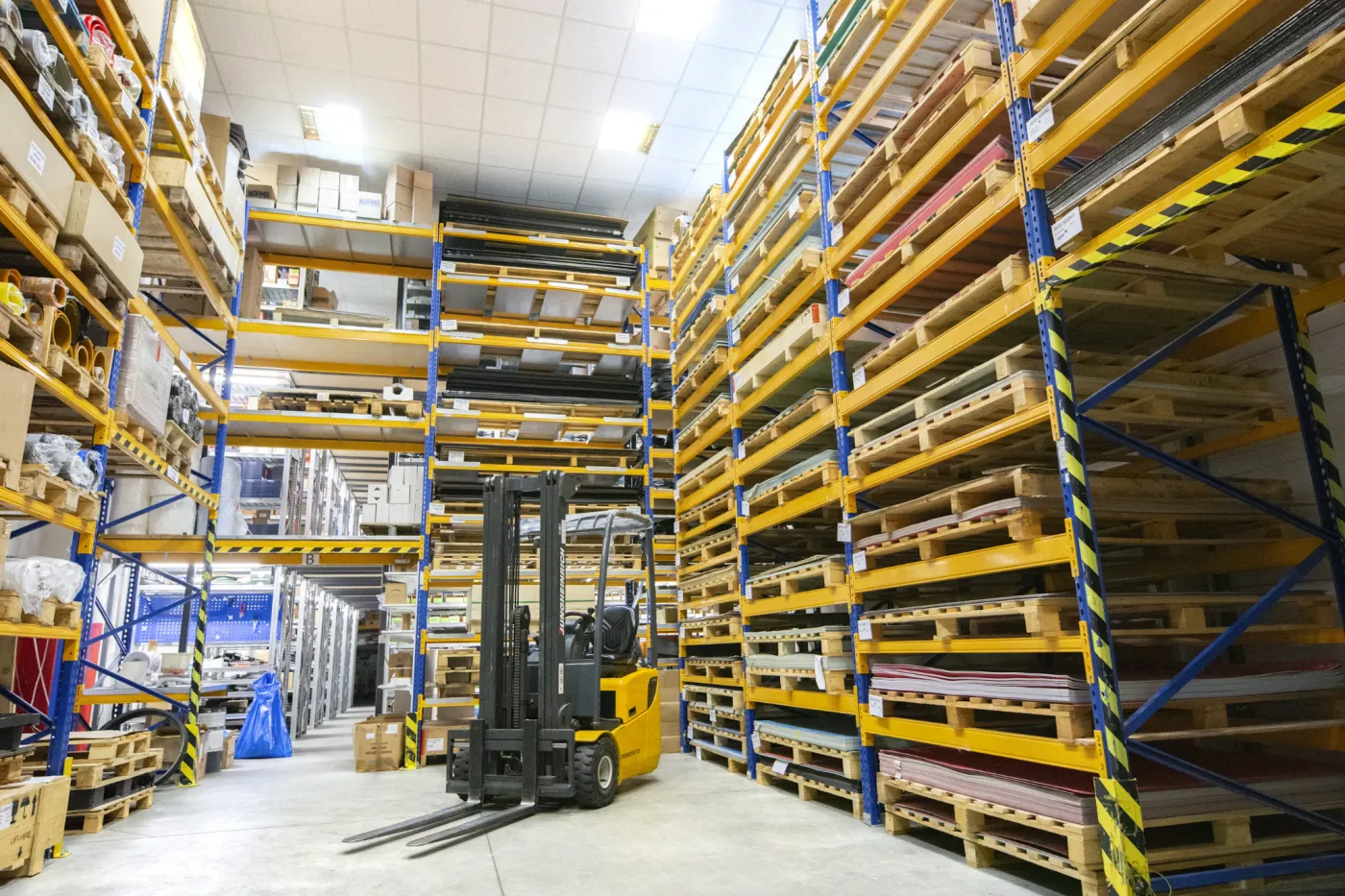
- Forklift and reach truck drivers. Receive putaway and replenishment tasks and confirm moves without leaving the truck.
- Pickers and packers. Report shortages, damaged stock and location errors from the aisle.
- Goods-in and receiving teams. Coordinate inbound vehicles, checks and discrepancies.
- Goods-out and dispatch teams. Confirm orders are complete and pallets are ready for loading.
- Loading bay and yard staff. Coordinate bay allocation, trailer movements and shunting.
- Stock control and inventory teams. Resolve location queries and run counts without paperwork going back and forth.
- Returns teams. Flag damaged or incorrect returns to stock control and customer service.
- Maintenance and engineering. Respond to breakdowns of conveyors, doors, chargers and lift trucks.
- Health and safety leads and first aiders. Respond to incidents and coordinate a safe response.
- Security and gatehouse staff. Manage vehicle arrivals and site access, often as the first point of contact for drivers.
- Cleaning and facilities teams. Report spills and hazards in active aisles.
- Night and lone shift workers. Stay connected to a supervisor when few people are on site.
Fewer talkgroups usually work better. A typical setup iPTT sees is 100 radios across five talkgroups, with management radios also joining the ground floor groups so managers can hear what is happening without being called. Most customers know the structure they want, and iPTT can help plan it.
How to Choose the Best Two Way Radios for Warehouse Use
The best two way radios for warehouse use are heard clearly over machinery, work hands-free on a forklift, survive drops and dust, last a full shift and support separate talkgroups. For night and lone working, they also need man down, lone worker mode and an emergency button. The right model then depends on the building, which the comparison below covers.
- Audio clarity in noise. Conveyors, reversing alarms and forklifts drown out small speakers. HSE sets noise action values at 80 and 85 dB(A), and staff in loud areas may already wear hearing protection, so check the radio works with noise cancelling earpieces or headsets that fit alongside it.
- Hands-free use for forklift drivers. Forklift and lift truck drivers shouldn’t be holding a radio while driving. iPTT supplies VOX earpieces and Bluetooth remote speaker microphones worn on the body that act as the push to talk button, and customers commonly allow an earpiece while driving.
- Durability. Radios get dropped on concrete and covered in dust. Check the IP rating and build quality.
- Battery life. A radio that dies before the end of a long shift creates a gap. Spare batteries and multi-unit chargers help on shift-based sites.
- Cold store use. In iPTT’s experience, PoC handsets cope with normal cold store use much like a mobile phone. Batteries still lose some capacity in the cold, so keep spares to hand on long shifts in chilled and frozen areas.
- Talkgroups. Separate groups for areas such as goods-in, dispatch and management stop every message going to everyone, and keeping the number of groups small makes them easier to use.
- Safety features. Man down raises an alarm automatically if a worker falls or stops moving, and lone worker mode raises one if a check-in is missed. Both matter for night shifts and isolated areas. HSE guidance on lone working names warehouses as a typical lone working setting and lists regular contact by radio, and alarms raised manually or automatically, as ways to manage the risk.
- Accessory compatibility. Radios that take existing accessories make an upgrade cheaper and simpler.
Traditional Radios vs PoC for Warehouses
Warehouses generally choose between licence-free PMR446 radios, licensed DMR radios and Push to Talk over Cellular (PoC). PMR446 suits small, simple sites. DMR works without a mobile network but needs a licensed frequency. PoC adds multi-site reach, GPS and central oversight, but depends on mobile signal or WiFi inside the building.
Licence-free PMR446 radios are cheap and easy to start with, but Ofcom limits them to 0.5 watts and everyone nearby shares the same 16 analogue channels, which can cause interference on busy industrial estates. Licensed DMR radios give more power and features such as man down. An Ofcom Simple UK Light licence costs £75 for five years and covers handheld radios anywhere in the UK, but it uses shared frequencies and does not allow base stations. Sites that need a repeater or their own frequency usually need a different licence type, which Ofcom prices per application.
PoC radios run over mobile networks and WiFi instead of radio frequencies. A warehouse team, the transport office and a second site can all share the same talkgroups, and managers can see live GPS positions through dispatcher software. There is no Ofcom licence or repeater to manage. The trade off is that every handset needs a usable connection, which is where in-building coverage comes in.
| Licence-free PMR446 | Licensed DMR | Push to Talk over Cellular | |
|---|---|---|---|
| Best suited for | Small single sites with simple needs | Single sites with weak mobile signal, where a licence is available | Warehouses that also need to reach drivers, managers or other sites |
| Coverage inside the building | Limited by low power | Good on open floors, extended with repeaters, basements can still be a problem | Depends on mobile signal or WiFi, basements can still be a problem |
| Coverage beyond the site | None | Limited to radio range | Anywhere with mobile coverage |
| Licensing | None | Ofcom licence, from £75 for five years | No spectrum licence |
| Privacy and interference | Shared channels, open to interference | Licensed channels, which may be shared with other licensees depending on the licence | Private talkgroups over encrypted data |
| Location and oversight | None | Possible with GPS radios and compatible dispatch software | Live GPS and central dispatcher as standard |
| Safety features | Rare | Man down and lone worker on suitable models | Man down and lone worker on suitable handsets |
| Key limitation | Range, interference and few features | Licence availability in busy areas and single-site focus | Needs mobile signal or WiFi inside the building |
Many warehouses don’t have to pick just one. A hybrid handset such as the iPTT P600 runs DMR and PoC in one device, which suits warehouses moving from DMR to PoC, since staff keep their existing DMR channel while gaining PoC reach.
Handling Coverage and Dead Spots in Large Buildings
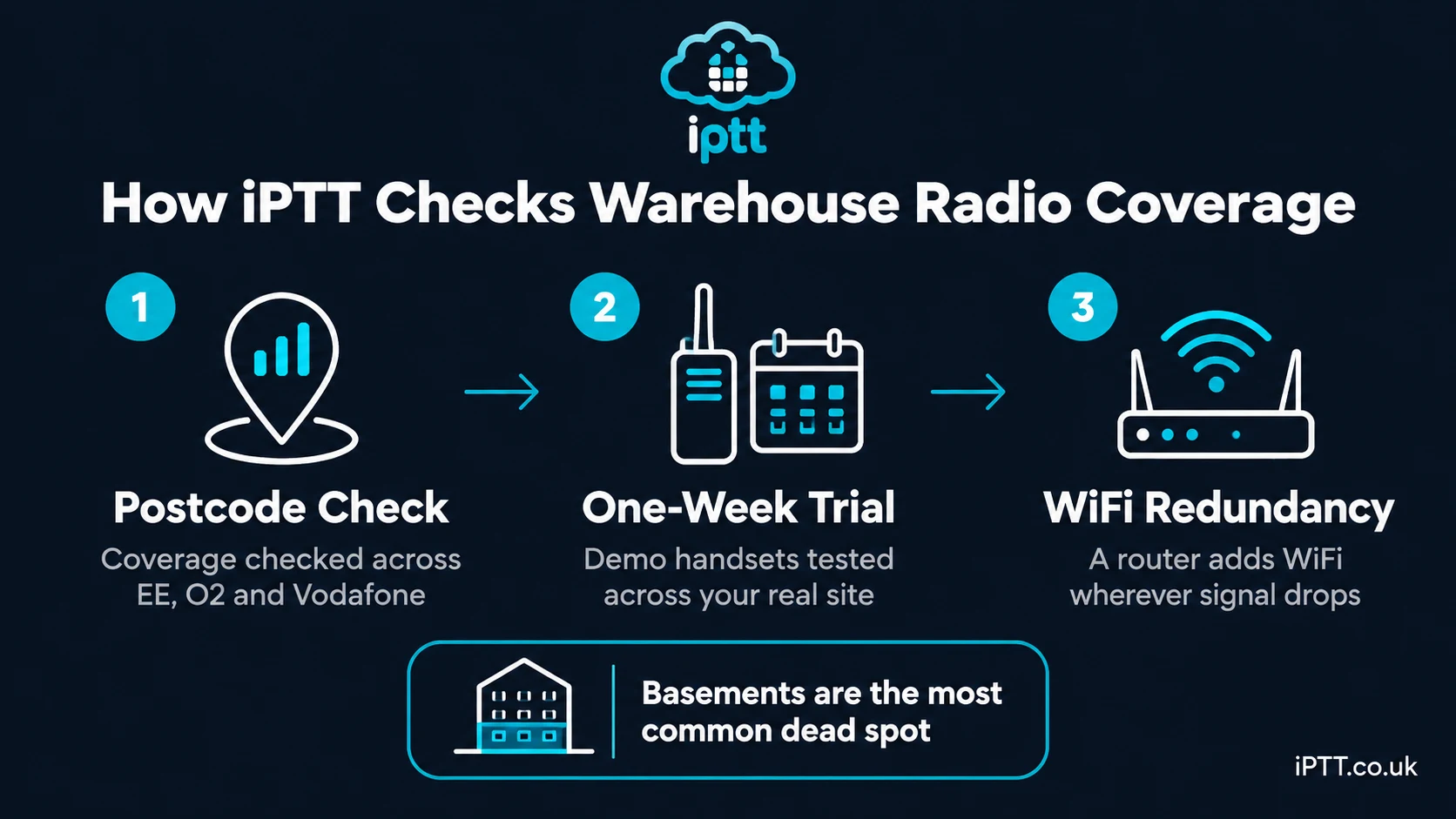
Most UK warehouses outside remote areas have usable mobile signal, and in iPTT’s experience, basements are the most common dead spot, for DMR and PoC radios alike. The fix is to check coverage before rollout, trial handsets on site, then add WiFi through a router wherever signal drops.
National coverage figures and advertised radio ranges don’t tell you what happens inside your building. Ranges in miles are usually quoted for open ground, not for a floor full of steel racking. Ofcom predicts that 96% of the UK landmass has good outdoor 4G coverage from at least one mobile operator, and 84% from all four (Ofcom, Connected Nations Spring 2026). Those are outdoor predictions, so they don’t guarantee signal below ground or deep inside a large steel-clad building.
“Basements are the main one, and that goes for DMR and PoC. But we can provide WiFi redundancy, and that works well.”
iPTT handles coverage in three steps.
- Check coverage by postcode. iPTT checks the warehouse postcode, and anywhere else the team needs to talk, across EE, O2 and Vodafone. Unless a site is in the middle of nowhere, there is usually coverage.
- Trial handsets on site. A demo of one or two units for a week shows how they perform across the real building, including basements, cold stores and the yard.
- Add WiFi redundancy where signal drops. A router puts the PoC radios on WiFi as well as 4G, so the building has a second route for every call. The iPTT P500 is iPTT’s WiFi model, and iPTT’s professional routers can prioritise push to talk traffic and fail over between networks if one drops.
A multi-network SIM also helps, because each handset can roam to whichever network is strongest at that spot rather than being tied to one operator.

What to Check Before Rolling Out a Warehouse Radio System
The right warehouse radio system depends on the building, the shift pattern and how far communication needs to reach. Work through these points before choosing hardware.
- Coverage check and trial. Check coverage at the postcode across networks, then trial handsets for a week in every zone, especially basements, cold stores and the yard.
- Noise and accessories. Check the speaker volume and which earpieces and headsets the radio supports.
- Hands-free for forklifts. Agree how drivers will communicate without taking their hands off the controls.
- Forklift safety. HSE reports lift trucks, including forklifts, are involved in about a quarter of workplace transport accidents. Make sure communication supports pedestrian and vehicle separation rather than adding distraction.
- Durability and temperature. Match the IP rating and operating temperature to the site, especially chilled and frozen areas.
- Battery and charging. Plan for full shifts, spare batteries and a charging point that fits shift handovers.
- Talkgroup structure. Map out who needs to hear what before the radios are programmed.
- Safety features. Man down, lone worker and an emergency button for night and isolated work.
- Oversight. Decide whether managers need GPS positions, call logging or a dispatcher view.
- Scalability. Consider peak season, agency staff and future sites, and whether licences or extra repeaters would be needed.
- Cost model. Licensed DMR means buying radios, an Ofcom licence and any repeaters. With iPTT, PoC means buying the handsets upfront, then renewing the licence and SIM card each year.
- Buy or hire. Radios are available to buy or hire through iPTT, from short-term hire for a busy period such as peak season to longer rentals of a year or more.
Before you commit. No system guarantees perfect coverage in every building. Trial any option on your own site, including basements and cold stores, before rolling it out.
Free Warehouse Radio Planning Pack
Our two-page planning pack helps you map out your talkgroups and test coverage across your site during a trial. Print it and work through it with your operations or site lead.
Download the Planning Pack (PDF)How iPTT Can Support Warehouse Communication
iPTT works with UK warehouses that are moving from DMR to Push to Talk over Cellular, usually so the warehouse floor, its drivers and its managers can all talk on one system. PoC handsets such as the P400 and P500 cover most sites, the P500 adds WiFi for areas where mobile signal drops, and iPTT’s routers add WiFi redundancy across the building. For teams that want to keep DMR during the move, the P600 runs both. iPTT checks coverage at the postcode first and can provide demo units so the site can be tested before anything is bought or committed to.
The iPTT Dispatcher gives managers one view of where staff are and who needs help, and the P400 and P600 both include man down, lone worker mode and an emergency button for night shifts.
See the P500’s WiFi, GPS and lone worker features in this short video from iPTT.
Conclusion
Two way radios keep warehouse teams connected across goods-in, picking, lift trucks and dispatch, and they give night and lone workers a direct line to help. The right system depends less on the radio itself and more on the building it has to work in.
Small sites with simple needs can start with licence-free radios. Single sites with weak signal and an available licence can suit DMR. Warehouses that need to reach drivers, managers or other sites benefit from PoC, with a router adding WiFi wherever signal drops. Whichever route a warehouse takes, a coverage check and a short trial on site must come first.
Talk to iPTT About Warehouse Radios
If you are reviewing how your warehouse teams stay connected, iPTT can talk you through handsets, coverage options and safety features for your specific site and situation.
FAQs
What are the best two way radios for warehouse use?
The best two way radios for warehouse use are professional models with loud audio, hands-free accessories, a rugged build and a battery that lasts a full shift. DMR suits single sites with weak mobile signal, while PoC suits warehouses that also need to reach drivers or other sites.
Do you need a licence for walkie talkies in a warehouse?
Walkie talkies are legal in UK warehouses, and the licence depends on the type. PMR446 radios need no licence, licensed DMR radios need an Ofcom Business Radio licence from £75 for five years, and Push to Talk over Cellular radios need no spectrum licence.
Will radios work across a large steel warehouse?
Radios usually work across a large warehouse, as most UK sites outside remote areas have mobile coverage. Basements are the most common dead spot, and a router adding WiFi alongside 4G can cover the gaps.
Can forklift drivers use a radio earpiece?
Yes, if the employer’s risk assessment allows it, and iPTT customers commonly do. VOX earpieces and Bluetooth speaker microphones keep hands on the controls while leaving one ear free for horns and alarms.
Do two way radios work in cold stores and freezers?
Yes. In iPTT’s experience, PoC handsets cope with cold store use much like a mobile phone. Batteries lose some capacity in the cold, so keep spares to hand and charge radios outside the cold store.
Are PoC radios better than traditional radios for warehouses?
PoC radios are better for warehouses that need to reach drivers, managers or other sites and have mobile signal or WiFi indoors. DMR suits single sites with poor mobile signal, and some warehouses use a hybrid radio that runs both.
How can warehouses improve team communication?
Move from phones and shouting to a radio system with separate talkgroups for each area. Check coverage and trial handsets on site, give forklift drivers hands-free kit and add man down for night shifts.
Sources
- Health and Safety Executive, Managing lift trucks
- Health and Safety Executive, Noise at work, advice for employers
- Health and Safety Executive, Protecting lone workers (INDG73)
- Ofcom, Business Radio licensing fees and payment
- Ofcom, Business Radio FAQs
- Ofcom, PMR446 information sheet
- Ofcom, Connected Nations update Spring 2026