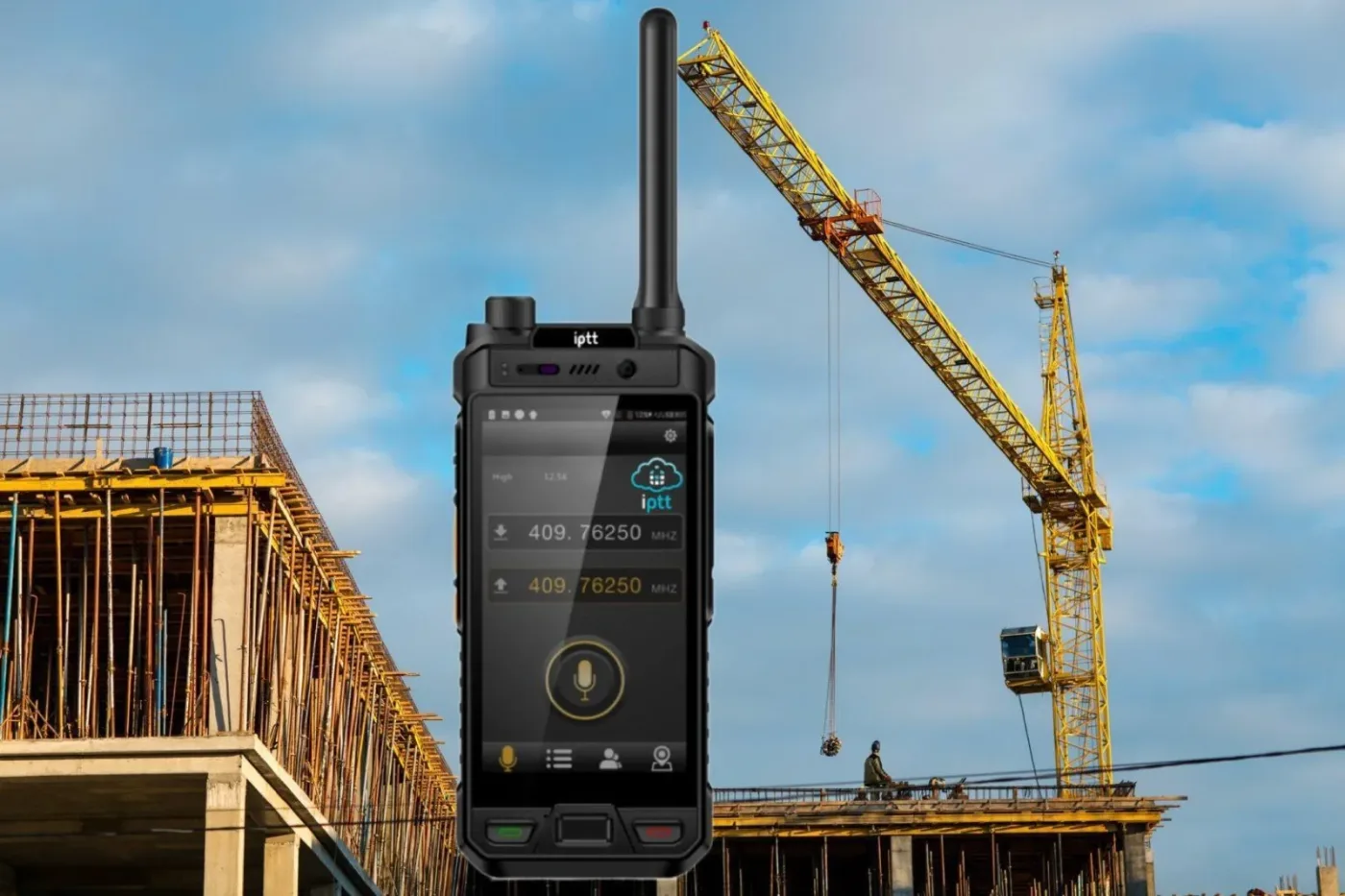
Two Way Radios for Construction Sites and How UK Site Teams Stay Connected
How UK construction teams use two way radios and Push to Talk over Cellular, how to choose a construction site communication system, and what to check before you buy or hire
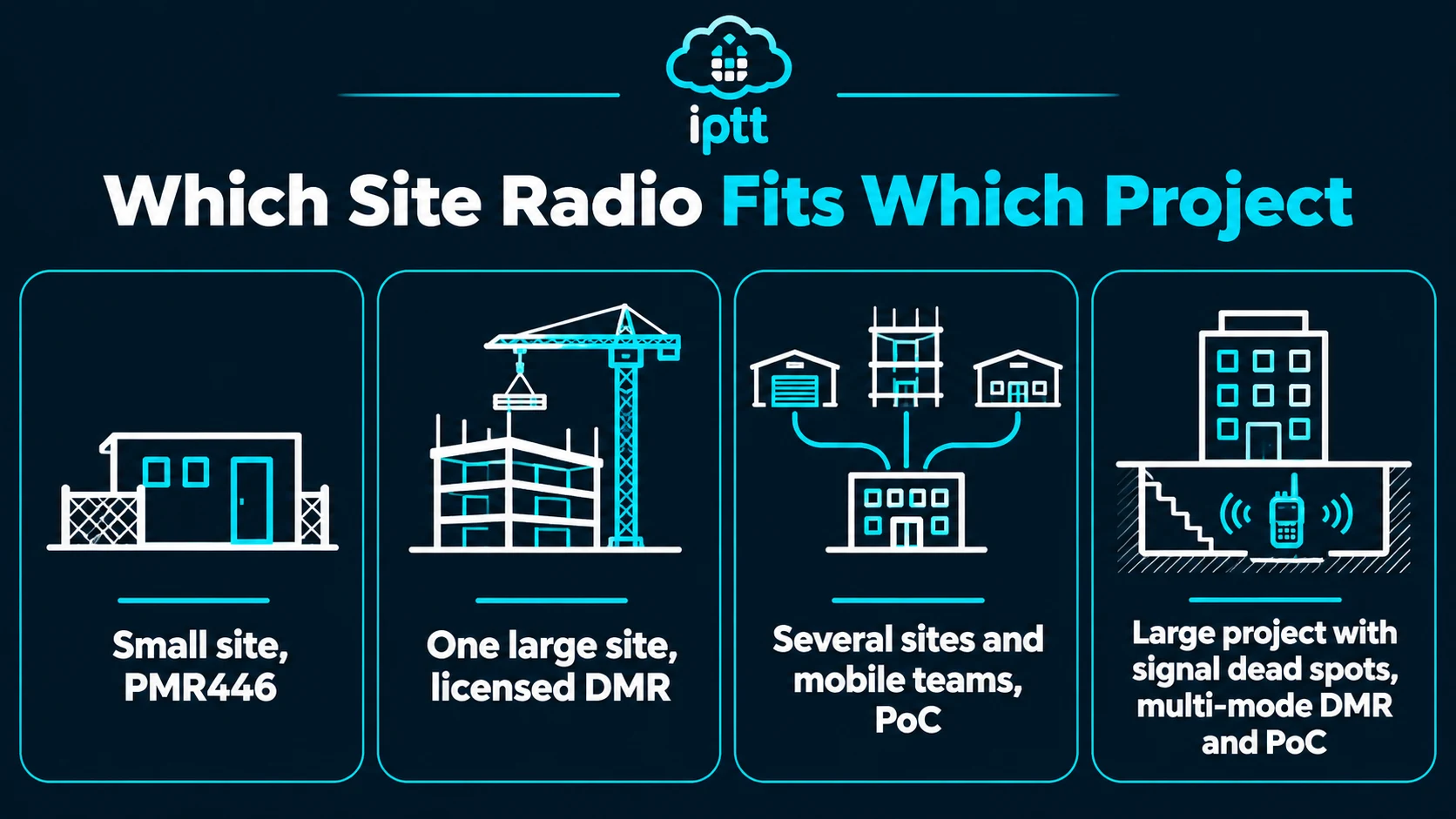
Two way radios for construction sites, often called walkie talkies, are push to talk radios that let site teams reach one person or a whole group instantly. UK sites use licence-free PMR446 radios for small jobs, licensed DMR radios for a single large site, Push to Talk over Cellular (PoC) radios for teams across several sites, and multi-mode DMR and PoC radios where mobile signal drops.
At 7am the first delivery arrives early and the gate needs to know where to send it. A tower crane is waiting on a slinger at level six. The groundworks foreman wants the site manager, who is in a progress meeting across the compound. And somebody on the night shift is checking the scaffold alone.
Every one of those conversations needs to reach the right person in seconds, often through concrete cores, steel frames and the noise of plant. This guide covers how site teams use radios, how PMR446, DMR and PoC compare, how to keep basements and upper floors connected, where crane lifts need their own channels, and what to check before buying or hiring a construction site communication system. It’s about radios for talking to each other on site, not jobsite radios for music.
What Construction Teams Use Radios For
Construction teams use radios to coordinate deliveries, vehicle movements, lifts, hazards and incidents across a working day. A radio reaches everyone on a talkgroup with one press, so the gate, the foremen and the site manager hear the same update at the same moment, with no dialling and no waiting for someone to answer.
A phone call reaches one person and has to be answered. On a busy site that means missed calls, voicemails and instructions passed down a chain. A radio puts the message in front of the whole team, and it works with gloves on and a hard hat on.
| Site area | How radio communication helps |
|---|---|
| Gate and logistics | Deliveries are booked in, held or sent to the right unloading area without anyone leaving the gate |
| Vehicle and plant movements | Banksmen and plant operators coordinate reversing, tipping and movements around pedestrians |
| Lifting operations | Slingers, signallers and crane operators work on a dedicated channel for each crane |
| Trades and subcontractors | Foremen from each trade reach the site manager and each other without walking the site |
| Health and safety | Hazards, near misses and incidents reach supervisors straight away |
| Emergencies and evacuation | Fire marshals and first aiders get one message out to everyone at once |
| Security and out of hours | Night security and lone workers stay in contact with a supervisor or monitoring centre |
| Multi-site management | Contracts managers and directors keep in touch with several projects from one handset |
Watch how radios support safety and coordination on active construction sites.
Who Uses Radios on a Construction Site
Almost everyone who directs work on a site uses a radio, from the site manager and foremen to banksmen, crane teams, gatemen and security. Most sites split users into a few talkgroups, such as general site, logistics and safety, with managers able to hear and reach every group.
- Project and construction managers. Keep up with progress and step in when priorities change.
- Site managers and assistant site managers. Run the day, redeploy labour and deal with problems as they come up.
- Site supervisors and trade foremen. Coordinate their gangs and hand over areas to the next trade.
- Subcontractor supervisors. Stay in contact with the main contractor without needing everyone’s mobile number.
- Gatemen and logistics coordinators. Manage deliveries, booking slots, access and the unloading area.
- Banksmen and traffic marshals. Direct reversing vehicles and plant movements around pedestrians.
- Plant operators. Excavator, dumper, telehandler and forklift operators coordinate with banksmen and the ground team.
- Slingers, signallers and appointed persons. Run lifting operations on a dedicated crane channel.
- Hoist and mast climber operators. Coordinate loads and people between floors.
- Health and safety advisers. Respond to hazards, near misses and incidents across the site.
- Fire marshals and first aiders. Raise the alarm and coordinate evacuation and first aid.
- Site engineers and setting-out teams. Coordinate surveys and setting out across large areas.
- M&E installation and commissioning teams. Work through plant rooms, risers and ceiling voids where phones often drop out.
- Security officers and night patrols. Cover the site out of hours, often alone.
- Contracts managers and directors. Oversee several sites and need to hear what is going on without ringing round.
Keep the number of talkgroups small. Most sites manage with one for general site traffic, one for logistics and the gate, and one for safety and emergencies, plus a separate dedicated channel for each crane.
Comparing Construction Radios (PMR446, DMR, PoC and Multi-Mode)
Construction sites generally choose between licence-free PMR446 radios, licensed DMR radios, Push to Talk over Cellular (PoC) and multi-mode radios that run DMR and PoC together. PMR446 and DMR work without a mobile network but are limited to radio range. PoC reaches anywhere with mobile coverage. Multi-mode radios give both on one handset.
PMR446 radios are the licence-free walkie talkies sold for building sites. They’re cheap, which is why they turn up on many smaller sites. They are low power and share the same small set of channels with everyone else, so range is short and you can pick up other users nearby, including other sites.
Licensed DMR radios are the traditional professional choice. They are tougher, louder and have more range than PMR446, typically 2 to 5 km line of sight, but walls, steel and floors cut that down. Covering a tall building or a large site usually means a repeater, and DMR needs an Ofcom licence.
PoC radios send push to talk calls over 4G, 5G and WiFi rather than radio frequencies. A site in Bristol, a yard in Bournemouth and a head office in Southampton can share one talkgroup, and there is no repeater or spectrum licence to manage. Ofcom predicts that 96% of the UK landmass has good outdoor 4G coverage from at least one mobile operator. The trade off is that PoC depends on that coverage, and basements and building cores are often where it drops.
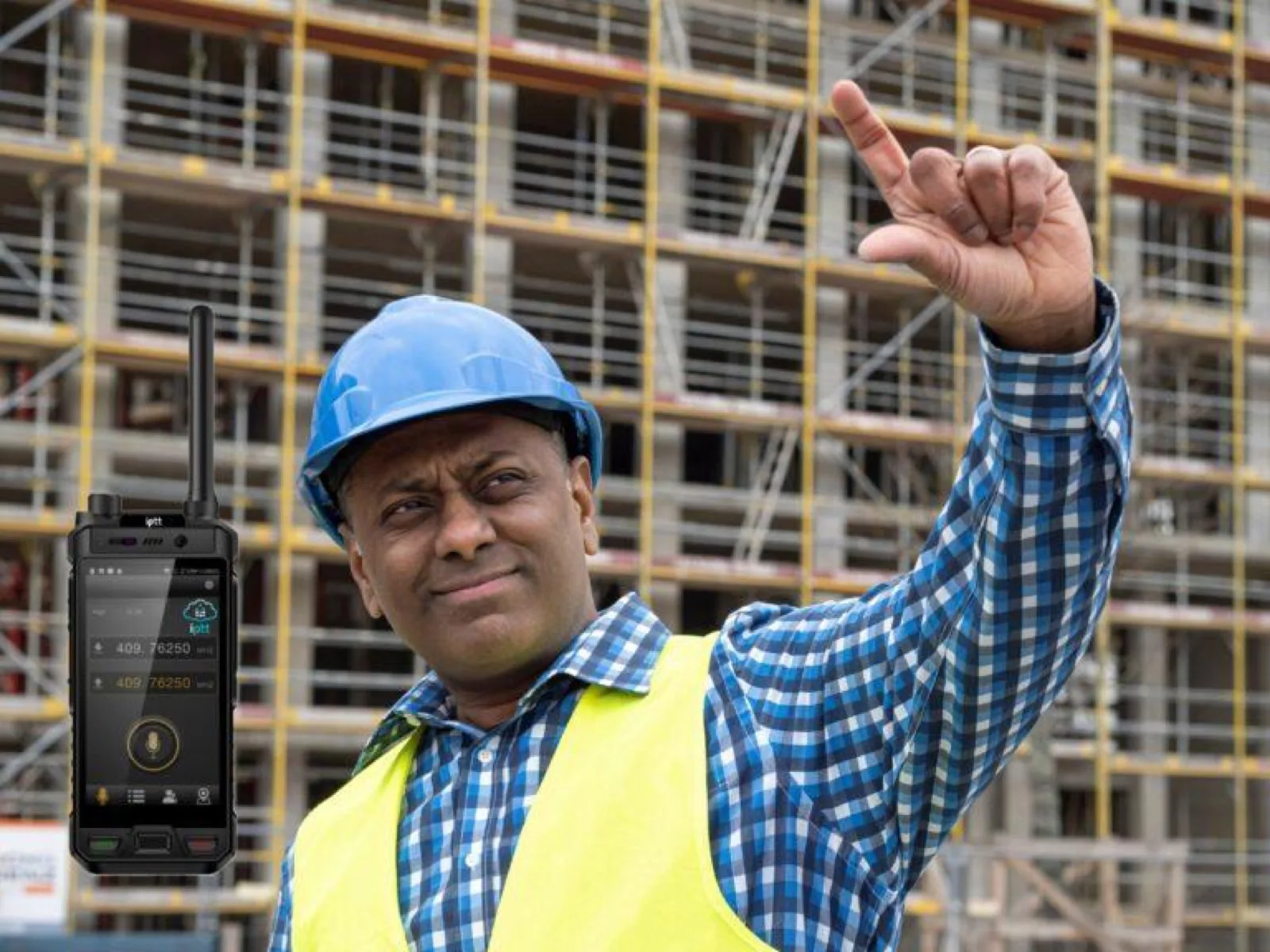
Multi-mode radios such as the iPTT P600 run DMR and PoC on one handset. Teams use PoC to reach other sites and the office, and switch to DMR for direct radio-to-radio contact where there is no mobile signal.
| PMR446 | Licensed DMR | Push to Talk over Cellular | Multi-mode (DMR and PoC) | |
|---|---|---|---|---|
| Best suited for | Small sites and short, simple jobs | A single large site | Several sites, mobile teams and large projects | Large projects that need wide reach plus a no-signal fallback |
| Coverage | Short range, cut down further by structures | Typically 2 to 5 km line of sight, more with repeaters | Anywhere with mobile coverage or WiFi | Both, switching between modes |
| Works without mobile signal | Yes | Yes | No | Yes, in DMR mode |
| Reaches other sites and the office | No | No, unless linked | Yes | Yes, in PoC mode |
| Licensing | Licence-free | Ofcom licence | No spectrum licence | Ofcom licence for the DMR side |
| Privacy | Shared channels anyone can hear | Shared or assigned frequencies, digital encryption available | Private talkgroups over the mobile network | Both |
| Location and oversight | None | Possible with GPS models and dispatch software | Live GPS and central dispatcher | Live GPS and dispatcher in PoC mode |
| Key limitation | Range, interference and no management | Range, repeaters and cost of linking sites | Basements, cores and other no-signal areas | Higher cost per handset |
Crane Lifts and Safety-Critical Communication
General site radios and lifting operations should be kept apart. Construction Plant-hire Association guidance on radio communication for lifting operations (TIN 017) recommends a dedicated channel for each crane, used only by that crane’s operator and its slinger or signaller, so general site traffic never cuts across a lift.
On congested sites the signaller is often out of the crane operator’s sight, so the lift relies on voice instructions. The same CPA guidance highlights loss of signal and interference from radios on adjacent sites as risks, and sets out unique call signs, standard voice commands and a separate “crash” channel for crane operators and the appointed person. The lift plan, not the general site radio setup, decides which radios and channels a lift uses.
In practice that means the radio plan for a site has two layers. Lifting teams use dedicated crane channels set up to the lift plan, usually on licensed radios. Everyone else uses the general site talkgroups, which is where PoC and multi-mode radios fit. Check any lifting arrangement against BS 7121, the lift plan and the appointed person before rollout.
| Communication | Typically handled by |
|---|---|
| Crane operator to slinger or signaller | Dedicated channel for each crane, set out in the lift plan |
| Crane operators and appointed person in an emergency | Separate restricted "crash" channel |
| Banksman to plant operator | Agreed signals or a dedicated radio channel, as set out in the traffic management plan |
| Site management, trades, gate and logistics | General site talkgroups on DMR, PoC or multi-mode radios |
| Contracts managers, head office and other sites | PoC or multi-mode radios in PoC mode |
Coverage in Basements, Cores and Upper Floors
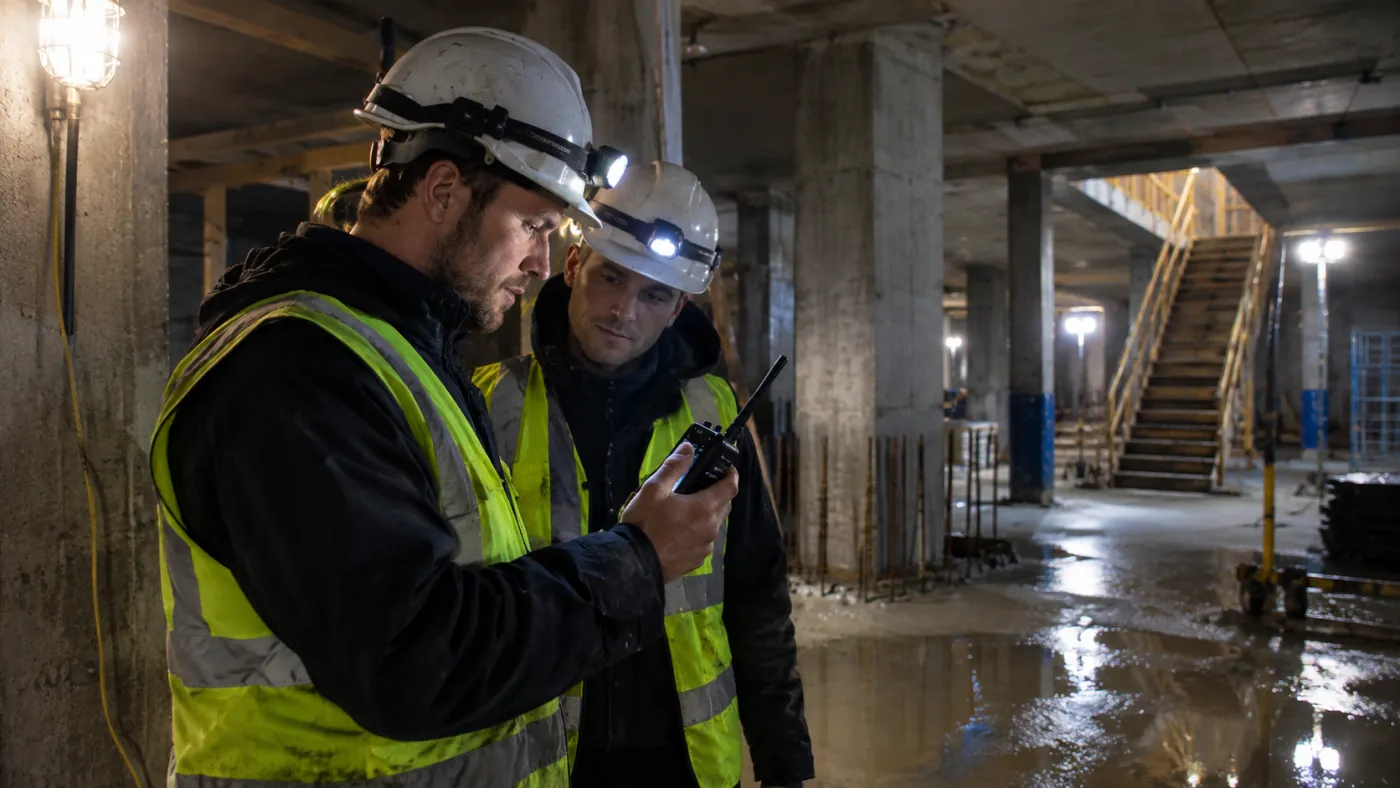
Signal behaves differently on a construction site than on open ground. Basements, lift cores, steel frames and concrete floors block both radio and mobile signal, and the picture changes as the building goes up. Test coverage across the real site, at different stages of the build, before choosing radios.
National coverage figures describe outdoor landmass. They say nothing about a third basement level or the inside of a concrete core, and a new building can lose signal on floors that had it a month earlier, once the cladding goes on. DMR has its own version of the problem, because range drops through each floor and wall unless a repeater is added.
There are a few ways to close the gaps.
- Walk the site with test handsets. Check the compound, the basement, the cores, the top working floor and the far corners of the site, and repeat the check as the structure changes.
- Use a multi-network SIM. iPTT’s multi-network SIM connects to the strongest available network rather than being tied to one operator, which helps where one network is weak on a particular site.
- Bring WiFi or signal into the building. A router in the site office or on an upper floor can carry PoC over WiFi into areas where mobile signal is poor, and cable repeaters can take it further into basements and plant rooms.
- Use multi-mode radios where there’s no signal at all. A DMR and PoC handset lets teams keep talking directly to each other on DMR when PoC drops out.
Safety Features for Lone Workers and High-Risk Tasks
Construction remains one of the highest-risk industries in Great Britain. HSE recorded 25 construction worker deaths in 2025/26 (provisional), against a five-year average of 37 a year, and falls from height accounted for over half of construction deaths over that period. Radio safety features don’t prevent accidents, but they get help to a worker faster.
Man down raises an alarm automatically if a worker falls or stops moving, which covers the cases where someone is hurt and can’t call for help. Lone worker mode raises an alarm when a worker misses a check-in. An emergency button lets anyone raise the alarm instantly, and GPS shows a responder where they are on a large site. For the wider picture on keeping isolated staff safe, see our guide to lone worker communication systems in the UK.
These features support the site’s emergency arrangements. They don’t replace a rescue plan for work at height, permits to work or the site induction.
Noise matters too. Check that the speaker is loud enough near breakers, saws and generators, and pick earpieces or headsets that work with ear defenders and hard hats.
Managing Radios Across Several Sites
Contractors running several projects need to manage radios as one fleet, not site by site. Dispatcher software shows where teams are and lets a manager talk to any site or group, and mobile device management (MDM) controls what each handset can be used for.
The iPTT Dispatcher gives a site office or head office live GPS positions on a map and lets operators talk to individual users or whole talkgroups. A contracts manager can see which supervisor is nearest an incident, or reach every site at once with a weather warning.
Because the iPTT P600 is also an Android smartphone, it can be managed through MDM. Administrators choose which apps and phone numbers each handset can use, so radios don’t become second phones. With iPTT’s compliance and business intelligence tools, every call and text sent or received is recorded, which gives a record to check when something goes wrong on site.
Costs, Licensing and Short-Term Hire
The cheapest radio to buy is not always the cheapest to run. PMR446 radios cost little but have no management or reach. DMR adds an Ofcom licence, plus repeaters for larger sites. PoC replaces those with a monthly subscription covering connectivity, software and support.
Ofcom’s light business radio licences, Simple UK and Simple Site, cost £75 for five years. They use shared frequencies, so on a crowded city site you can hear or be heard by neighbouring users. Exclusive frequencies need a technically assigned licence, which costs more and takes longer to issue.
PoC has no spectrum licence and no repeaters. Teams can be added or removed as the project changes, which suits contractors whose headcount rises and falls through a build.
For short projects, hiring is often simpler than buying. iPTT radios can be hired for the length of a project through partners such as Speedy Hire, so you aren’t left with spare handsets when the job finishes.
What to Check Before Choosing Site Radios
The right radios depend on the size of the site, how long the project runs, where people work and how many sites need to talk to each other. Work through these points before buying or hiring.
- Site size and number of sites. One contained site, one large site, or several projects that need to talk to each other and the office.
- Coverage on the real site. Test handsets in the compound, basements, cores and upper floors, and recheck as the structure goes up. Ofcom’s 96% figure is outdoor landmass coverage, so it doesn’t guarantee signal underground or inside a concrete frame.
- No-signal fallback. Decide how teams stay connected where mobile signal drops, whether that’s WiFi, a router with cable repeaters or DMR on a multi-mode radio.
- Crane and plant channels. Agree dedicated channels for each crane with the appointed person, and keep them separate from general site traffic.
- Talkgroup structure. Map who needs to hear what across management, trades, logistics, safety and security before programming the radios.
- Lone worker and high-risk work. With falls from height behind over half of construction deaths over the last five years (HSE), check the radios support man down, lone worker mode and an emergency button.
- Noise and PPE. Check speaker volume, and choose earpieces and headsets that work with hard hats and ear defenders.
- Durability and battery. Match the IP rating to dust, rain and drops, and make sure batteries last a full shift.
- Licensing and interference. Check whether the radios need an Ofcom licence, and whether neighbouring sites could interfere on shared channels.
- Project length and scalability. Decide whether to buy or hire, and whether the system can grow or shrink with the workforce.
Before you commit. No radio system guarantees coverage across every part of a construction site. Trial any option on your own site, including basements and upper floors, before rolling it out.
Download the Site Radio Selection Worksheet, a free two-page guide to choosing radios, checking coverage and planning channels for your site.
Download the Worksheet (PDF)How iPTT Can Support Construction Projects
iPTT supplies push to talk communication for construction teams, from a single site to contractors running several projects. That includes PoC handsets, the iPTT P600 multi-mode radio with DMR and PoC in one, a multi-network SIM, man down and lone worker features, and the iPTT Dispatcher for site and head office oversight.
Where signal is poor, iPTT can add WiFi, routers or multi-mode radios so teams stay connected in basements and cores. Radios can be bought from iPTT or hired for the length of a project through partners such as Speedy Hire, and iPTT collaborates with Speedy Hire to support remote construction sites across the UK.

“Too often site communication is siloed. Teams talk among themselves on site, management is left out of the loop, and things end up on WhatsApp, which isn’t streamlined. The best setup puts site teams, management groups and dispatchers on one system, so everyone can hear what’s happening and make sure work stays compliant.”
iPTT can check coverage on your site and provide demo units, so your teams can test radios where they actually work before anything is bought or hired.
Conclusion
Radios carry the conversations that keep a construction site moving and safe, between the gate, the trades, the cranes and the site office. They also give lone workers and people doing high-risk work a fast way to get help.
For a small, contained site, PMR446 or DMR does the job. For contractors running several sites, PoC reaches further and is easier to manage. Projects that need both choose a multi-mode radio. Whichever you choose, keep crane lifts on their own channels and test the radios on your own site, basements included, before you commit.
Talk to iPTT About Radios for Construction Sites
If you’re planning communication for a new project, or your current radios don’t reach every part of the site, iPTT can talk you through handsets, coverage, hire and safety features.
FAQs
What are the best two way radios for construction sites?
It depends on the site. PMR446 radios suit small, simple jobs. Licensed DMR radios suit a single large site. Push to Talk over Cellular radios suit contractors with several sites or teams spread over a large area. Multi-mode radios that run DMR and PoC suit large projects with signal dead spots.
What is a construction site communication system?
A construction site communication system is the set of radios, talkgroups and supporting equipment a site uses to keep teams in contact. It usually includes handheld radios, separate channels for cranes and logistics, and often a dispatcher or site office console, repeaters, routers and safety features such as man down.
Do you need a licence for two way radios on a construction site?
Licence-free PMR446 radios need no licence. Licensed DMR radios need an Ofcom business radio licence, and the Simple UK and Simple Site licences cost £75 for five years. Push to Talk over Cellular radios use mobile networks, so they need no spectrum licence.
Do construction site radios work without mobile signal?
PMR446 and DMR radios work without mobile signal because they talk radio to radio, within radio range. PoC radios need mobile signal or WiFi. Multi-mode radios run both, so teams can switch to DMR where mobile signal drops, such as in basements.
What is the difference between a walkie talkie and a two way radio?
A walkie talkie is a handheld two way radio, so on site the terms mean the same thing. Two way radio is the wider term and also covers radios fitted in vehicles, plant and site offices. PoC radios work like a walkie talkie but send calls over mobile networks, so range isn’t limited to radio distance.
How far do construction radios reach?
PMR446 radios have the shortest range. Licensed DMR radios typically reach 2 to 5 km line of sight, less through concrete and steel, and further with a repeater. PoC radios have no fixed range limit, because they work anywhere with mobile coverage or WiFi.
Can PoC radios be used for crane lifts?
Crane lifts should follow the lift plan and industry guidance, which calls for a dedicated channel for each crane between the operator and the slinger or signaller. Most sites use licensed radios set up for this. PoC radios are used for general site communication alongside them.
Can you hire radios for a construction project?
Yes. Hiring suits short projects and peaks in the workforce, because you pay for radios only while you need them. iPTT radios can be hired for the length of a project through partners such as Speedy Hire, and iPTT sells handsets for longer-term use.
How can contractors improve communication on construction sites?
Put management, trades, logistics and safety on separate talkgroups, with dedicated channels for each crane. Test coverage across the real site, including basements and upper floors, and plan a fallback where signal drops. Choose radios with man down and an emergency button for lone and high-risk work.